You run an ad.
People see it.
Some click.
But then something strange happens.
You look at your campaign and see a good number of clicks, yet hardly anyone fills out the form, calls your business, sends a WhatsApp message, or makes a purchase.
So what went wrong?
The answer often comes down to two numbers that sound similar but tell you completely different things:
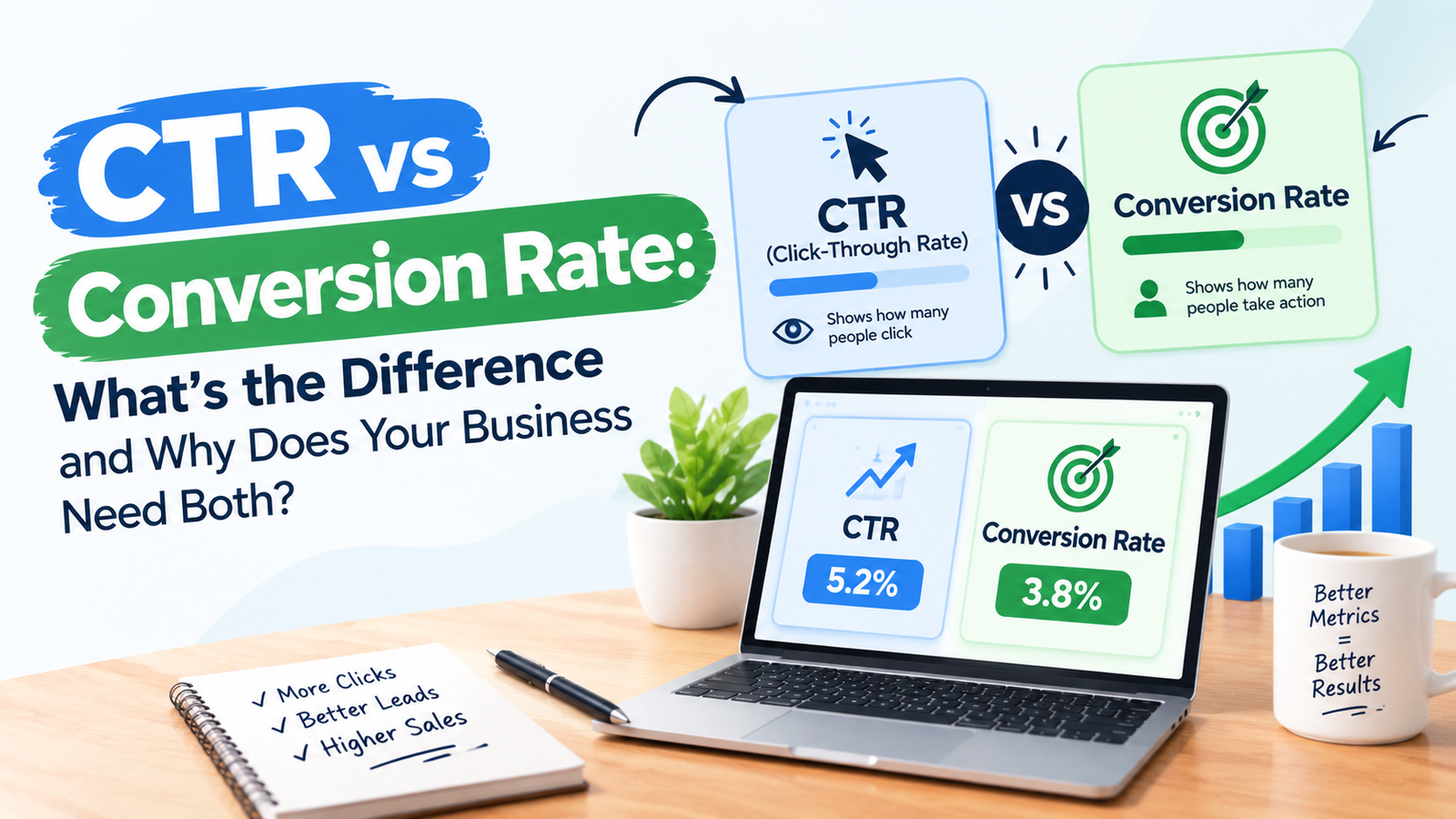
CTR (Click-Through Rate) and Conversion Rate.
CTR tells you how successful you are at getting people to click.
Conversion Rate tells you what happens after they click.
And if you’re running Google Ads, Meta Ads, or driving traffic through SEO, understanding the difference can save you from making the wrong changes to your campaign.
What Is CTR?
CTR stands for Click-Through Rate.
It measures the percentage of people who saw your ad or listing and clicked on it.
The basic formula is:
CTR = Clicks ÷ Impressions × 100
For example, imagine your Google ad was shown 10,000 times and received 500 clicks.
Your CTR would be:
500 ÷ 10,000 × 100 = 5%
So your CTR is 5%.
Google defines CTR as the number of clicks divided by the number of times an ad or listing was shown. Google also notes that what counts as a “good” CTR depends on what you’re advertising and where the ad appears.
What does a good CTR tell you?
A healthy CTR can suggest that your:
- Ad is relevant to the audience
- Headline catches attention
- Offer is interesting
- Keyword and ad are closely connected
- Message matches what people are looking for
But there’s an important point:
A click is not a customer.
That’s where conversion rate comes in.
What Is Conversion Rate?
Conversion Rate measures how often people who interact with your campaign complete the action you actually want.
That action could be:
- Buying a product
- Filling out a form
- Calling your business
- Sending a WhatsApp message
- Booking an appointment
- Signing up
- Requesting a quote
- Downloading something
The formula is generally:
Conversion Rate = Conversions ÷ Relevant Interactions × 100
For example:
Your ad receives 500 clicks.
Out of those 500 visitors, 25 people submit your enquiry form.
Your conversion rate would be:
25 ÷ 500 × 100 = 5%
Google Ads similarly defines conversion rate as conversions divided by the eligible ad interactions that can be attributed to those conversions.
So now we have two different numbers:
CTR = Did people click?
Conversion Rate = Did they take the action we wanted?
That’s the difference.
CTR vs Conversion Rate: The Simple Difference
Here’s the easiest way to remember it:
| Metric | What it tells you | Example |
|---|---|---|
| CTR | How many people clicked after seeing your ad | 5% |
| Conversion Rate | How many people converted after interacting | 5% |
| Main focus | Ad/message appeal | Landing page + offer + audience + overall experience |
| Question it answers | “Did I get the click?” | “Did I get the customer action?” |
Think about it like a shop.
Your advertisement is the person standing outside the shop saying:
“Come inside.”
CTR tells you how many people actually walked through the door.
Conversion Rate tells you how many of those people actually bought something or contacted you.
You need both numbers to understand what’s really happening.
Why a High CTR Doesn’t Always Mean a Successful Campaign
This is where many businesses make a mistake.
They see:
CTR: 8%
and immediately think:
“My ad is performing really well.”
Maybe.
But let’s look deeper.
Suppose your campaign receives:
20,000 impressions
1,600 clicks
That’s an 8% CTR.
Sounds great.
But after those 1,600 clicks, only 8 people become leads.
That’s a conversion rate of:
8 ÷ 1,600 × 100 = 0.5%
Now you have a different story.
Your advertisement is getting attention.
But something after the click may be stopping people from taking action.
The problem could be:
- Weak landing page
- Poor offer
- Wrong audience
- Slow website
- Confusing message
- High price
- Lack of trust
- No clear CTA
- Poor mobile experience
- Mismatch between the ad and landing page
This is why looking at CTR alone can give you the wrong picture.
What If Your CTR Is Low but Your Conversion Rate Is High?
This situation can also happen.
Imagine your advertisement receives:
10,000 impressions
Only 200 clicks
Your CTR is:
2%
That may look weak at first.
But suppose those 200 visitors generate:
30 qualified leads
That’s a 15% conversion rate.
Now think about what that tells you.
The ad may not be attracting a huge number of people, but the people who do click may be highly relevant.
For a business focused on leads or sales, that information matters.
You shouldn’t automatically destroy the campaign simply because the CTR isn’t as high as another campaign.
Look at the quality of the traffic too.
The Real Problem: You Need to Look at the Whole Journey
A customer doesn’t usually go from:
Ad → Purchase
in one magical step.
There is a journey.
For example:
Impression
↓
Click
↓
Landing page
↓
Trust
↓
Offer
↓
Enquiry
↓
Sales conversation
↓
Customer
CTR mainly tells you about the step between impression and click.
Conversion Rate helps you understand what happens after that interaction.
If you only monitor CTR, you’re looking at one part of the journey.
What Can Improve Your CTR?
If your CTR is low, start by looking at your advertisement and targeting.
1. Improve Your Headline
Your headline needs to communicate something people actually care about.
Instead of:
“Digital Marketing Services”
try communicating a clearer benefit:
“Get More Qualified Leads From Google”
The exact wording should depend on your audience and offer, but the principle is simple:
Talk about the customer’s problem or desired outcome.
2. Make the Offer Clear
People should quickly understand what they’re getting.
For example:
Free Website SEO Audit
is much easier to understand than:
Complete Digital Growth Solutions
The second sounds professional.
The first tells me exactly what I’m being offered.
3. Match the Search or Audience
If your advertisement promises one thing but the person lands on a page about something else, you create friction.
The closer the connection between:
Search → Ad → Landing Page
the clearer the experience becomes.
Google also recommends creating relevant ad text and strong keyword relationships when working to improve clicks and CTR.
4. Test Different Messages
Sometimes the problem isn’t your entire campaign.
It may simply be the way the offer is being presented.
Test different:
- Headlines
- Offers
- Calls to action
- Benefits
- Audience segments
- Creative formats
Then compare the results.
What Can Improve Your Conversion Rate?
Now let’s assume your CTR is good.
People are clicking.
But they’re not becoming customers.
Your attention should move from the advertisement to what happens after the click.
1. Make Your Landing Page Match the Ad
If your advertisement says:
“Get a Free SEO Audit”
but the landing page immediately talks about five different marketing services, the visitor may become confused.
Keep the journey simple.
The visitor should immediately understand:
“Yes, this is what I clicked for.”
2. Make Your CTA Obvious
Don’t make visitors search for what to do next.
Tell them.
Examples:
Get My Free Audit
Book a Consultation
Request a Quote
Talk to an Expert
Send a WhatsApp Message
Your CTA should match the action you actually want.
3. Build Trust Before Asking for the Lead
People don’t hand over their details simply because you ask.
They want to know:
Can I trust this business?
Your landing page can build trust through:
- Genuine testimonials
- Case studies
- Client results
- Business information
- Clear pricing where appropriate
- Real team information
- Portfolio examples
- Reviews
- Contact details
- Relevant certifications or credentials
Don’t add fake reviews or exaggerated results.
Trust works better when the evidence is real.
4. Remove Unnecessary Friction
Imagine someone wants to enquire about your service.
You ask them to fill out:
- Name
- Phone
- Company
- Website
- Industry
- Budget
- Address
- Company size
- Ten other questions
You may have just made a simple enquiry feel like an application form.
Only ask for information you genuinely need at that stage.
CTR vs Conversion Rate Can Tell You Where the Problem Is
This is where these two metrics become really useful.
Situation 1: Low CTR + Low Conversion Rate
Possible issue:
Your targeting, message or offer may need attention.
You aren’t getting enough people to click, and the people who do click aren’t taking action.
Situation 2: High CTR + Low Conversion Rate
Possible issue:
Your advertisement is attracting attention, but something after the click isn’t working well enough.
Look at:
- Landing page
- Offer
- Audience quality
- Pricing
- Trust
- CTA
- Page speed
- Message match
Situation 3: Low CTR + High Conversion Rate
Possible issue:
Your traffic volume may be limited, but the visitors you attract are valuable.
You could test new ad messaging or expand reach carefully without losing the audience quality.
Situation 4: High CTR + High Conversion Rate
Now you have a much healthier picture.
People are clicking, and a meaningful percentage are taking the desired action.
At this point, the next questions become:
- Can you scale it?
- Is the cost profitable?
- Are the leads actually qualified?
- Are those leads becoming customers?
Because conversion rate alone isn’t the final business metric either.
CTR Isn’t the Same as Sales
This is worth repeating.
You can have:
Excellent CTR
Excellent conversion rate
and still have a disappointing campaign if the conversions aren’t valuable.
Imagine two campaigns.
Campaign A
1,000 clicks
100 leads
10 customers
Campaign B
500 clicks
50 leads
20 customers
Campaign B generated fewer clicks and fewer leads but more customers.
That’s why marketers should avoid judging a campaign using one metric in isolation.
Look at the entire path from traffic to revenue.
What About SEO? Does CTR Matter There Too?
Yes, but be careful about drawing conclusions from CTR alone.
In organic search, Search Console can show metrics such as:
- Impressions
- Clicks
- CTR
- Average position
If your page receives many impressions but very few clicks, it can be worth reviewing how the page appears in search.
Look at:
- Page title
- Search intent
- Relevance
- Search snippet
- Content quality
- Competition
- The actual query triggering the impression
But don’t assume that simply increasing organic CTR will automatically make Google rank the page higher.
Search performance involves many different systems and signals.
CTR is a useful measurement of how often searchers click after seeing a result; it isn’t a complete explanation of why a page ranks where it does.
How E-E-A-T Fits Into CTR and Conversion Rate
If you’re creating content around marketing metrics, don’t make the article just another dictionary-style definition.
That’s where E-E-A-T becomes important.
Google’s guidance emphasizes creating helpful, reliable, people-first content and considering who created the content, how it was produced, and why it exists. Google’s current documentation also says the helpful content system became part of its broader core ranking systems.
For a marketing article like this, demonstrate those principles rather than simply mentioning them.
Experience
Explain situations marketers actually encounter.
For example:
“We’ve seen campaigns where the ad generated plenty of clicks, but the landing page was responsible for losing potential leads.”
Only use this kind of statement if it reflects your genuine experience.
Expertise
Explain the metrics correctly and show how they should be interpreted together.
Authoritativeness
Support definitions and technical claims with reliable sources, particularly when discussing advertising platforms or Google’s products.
Trust
Don’t promise things such as:
“Increase your conversion rate by 500% guaranteed.”
Marketing performance depends on the audience, offer, market, tracking setup and many other factors.
Be honest about what the data can and cannot tell you.
How to Calculate Both Metrics
Let’s make this extremely simple.
CTR
You receive:
10,000 impressions
400 clicks
Formula:
400 ÷ 10,000 × 100 = 4% CTR
Conversion Rate
Those 400 clicks produce:
20 conversions
Formula:
20 ÷ 400 × 100 = 5% conversion rate
So your campaign has:
CTR: 4%
Conversion Rate: 5%
But remember that the exact denominator for conversion rate depends on the platform and conversion definition you’re using. Google Ads, for example, calculates its conversion-rate metric using eligible ad interactions attributable to conversions.
Which One Should You Focus On?
The answer depends on what you’re trying to achieve.
If your main problem is:
“Nobody is clicking my ads.”
Look closely at CTR.
If your problem is:
“People are clicking, but nobody is contacting us.”
Look closely at conversion rate.
If your problem is:
“We’re getting leads, but not enough sales.”
Go one step further.
Look at:
Lead quality → Sales rate → Cost per customer → Revenue → Profit
That’s where marketing becomes a business decision rather than just a dashboard exercise.
A Simple Way to Diagnose Your Campaign
Before changing anything, ask these five questions:
1. Are people seeing my ad?
Look at impressions.
2. Are they clicking?
Look at CTR.
3. Are they taking the desired action?
Look at conversion rate.
4. Are those conversions valuable?
Look at lead quality or purchase value.
5. Is the campaign actually profitable?
Look at revenue and return on ad spend or your chosen profitability metric.
This prevents you from celebrating a high CTR while ignoring poor sales—or turning off a campaign that has fewer clicks but much better customers.
Final Thoughts
CTR and Conversion Rate are connected, but they are not the same thing.
CTR tells you whether your message is getting people to click.
Conversion Rate tells you whether those interactions are turning into the action you actually want.
Neither metric tells the entire story on its own.
A strong campaign needs the whole journey to work:
Right audience → Right message → Click → Good experience → Clear offer → Conversion → Customer
So the next time you open your advertising dashboard and see a CTR number, don’t stop there.
Ask what happened after the click.
And if your conversion rate is low, don’t immediately blame the ad.
The problem could be the landing page, offer, audience, pricing, trust, messaging, tracking or the overall customer journey.
The click gets attention.
The experience earns the conversion.