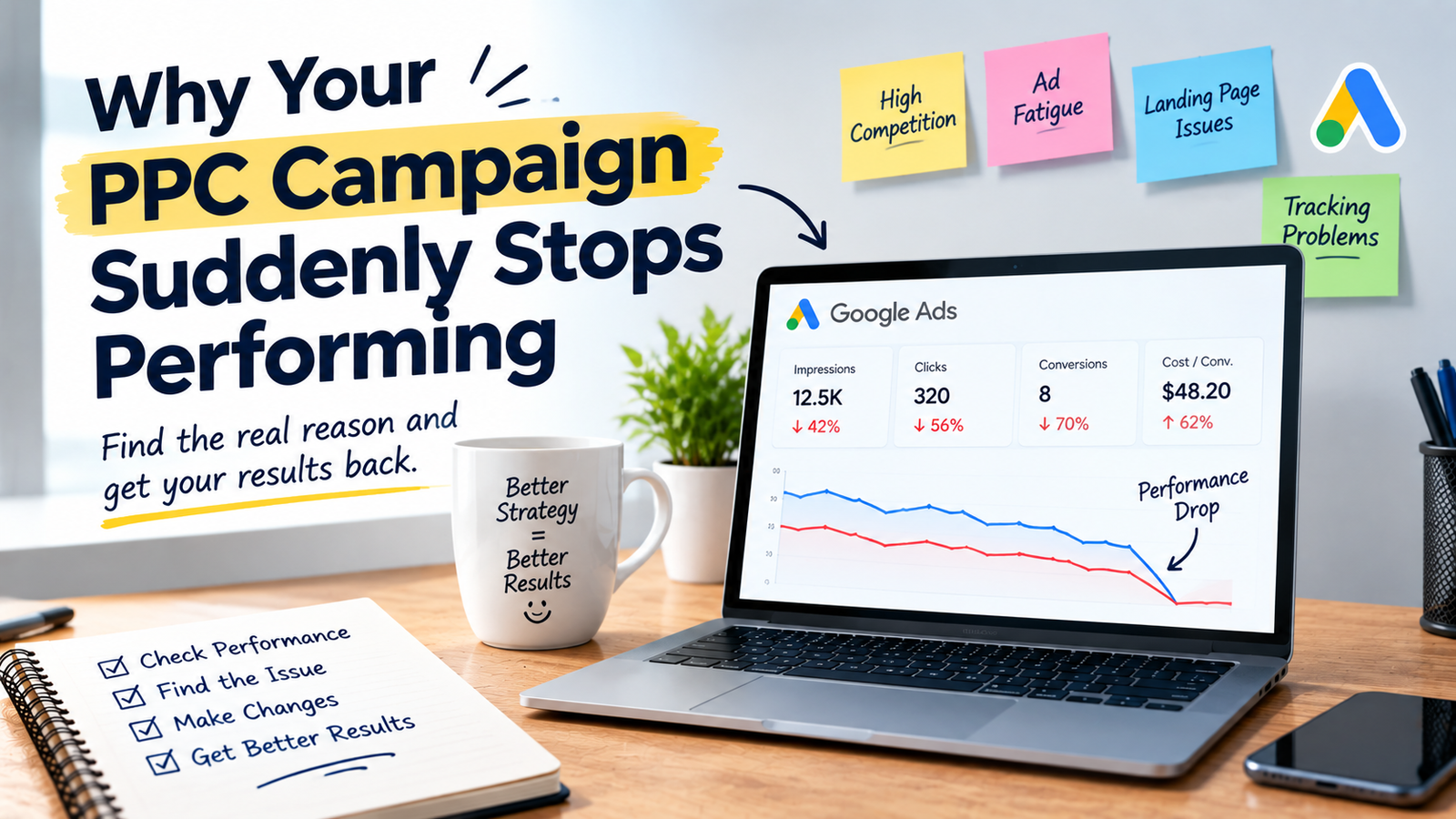
Why your PPC campaign suddenly stops performing is a frustrating problem, especially when your ads were bringing results before. However, a sudden drop in clicks, conversions, or return doesn’t always mean the entire campaign is broken. Instead, the problem could be related to your targeting, search terms, competition, landing page, budget, or conversion tracking.
The first reaction is often to increase the budget or change everything inside the campaign.
That isn’t always the right move.
PPC campaigns can lose performance for many reasons, including increased competition, audience changes, ad fatigue, landing-page problems, tracking issues, search-term changes, or a mismatch between your ads and what people are actually looking for.
The good news is that a sudden drop doesn’t always mean your campaign is broken. In many cases, you can find the problem by looking at the right numbers and making a few focused changes.
In this guide, we’ll explain why your PPC campaign suddenly stops performing, what you should check first, and how to improve your campaign without wasting more of your advertising budget.
What Does a Drop in PPC Performance Actually Mean?
A drop in PPC performance can show up in different ways. For example, your clicks may decrease while your costs increase. At the same time, conversions may fall even though your ads are still receiving traffic. Therefore, the first step is to identify exactly which metric has changed.
These are different problems and they don’t necessarily have the same solution.
If clicks are falling but your conversion rate remains healthy, the problem may be related to visibility, competition, budget, or targeting.
If clicks remain stable but conversions have dropped, the problem may be happening after the click.
That’s why you shouldn’t immediately change your entire campaign.
Find where the drop is happening first.
Why Your PPC Campaign Suddenly Stops Performing
There isn’t always one single reason for a performance drop.
Let’s look at the problems you should check before making major changes.
1. Your Competition Has Changed
First, consider your competition, PPC doesn’t happen in isolation.
Other businesses are bidding for the same customers, and their strategies can affect your results.
A competitor may:
- Increase their advertising budget
- Start bidding on your keywords
- Improve their ad copy
- Offer a different deal
- Create a stronger landing page
- Target the same audience more aggressively
When competition changes, the cost and visibility of your ads can change as well.
This is one possible reason why your PPC campaign suddenly stops performing even when you haven’t made major changes yourself.
Don’t assume your campaign suddenly became bad.
The market around it may have changed.
If you want to compare your campaign with a more structured approach to paid search, you can also explore Digitalmarkz’s Google Ads services, where campaign structure, tracking, targeting, landing pages, and conversion performance are all considered together. Google Ads services by Digitalmarkz
2. Your Ads Have Become Less Effective
Another common reason is ad fatigue, people see a huge number of advertisements every day.
If the same ad keeps appearing to the same audience, people may gradually stop paying attention.
You might notice:
- Lower CTR
- Fewer clicks
- Lower engagement
- Higher costs
- Fewer conversions
If you’ve been using the same headlines, descriptions, images, or offers for a long time, test fresh variations.
But don’t change everything at once.
Test specific changes so you can understand what actually affected the result.
3. Your Target Audience Is Too Broad
More people seeing your ad doesn’t automatically mean more customers.
If your targeting is too broad, your ads may reach people who aren’t genuinely interested in your offer.
For example, a company selling premium interior design services doesn’t necessarily need to advertise to everyone searching for “home decor.”
Some people may only be looking for inspiration.
Others may be students researching design.
Others may not have any intention of hiring a designer.
A smaller, more relevant audience can be more useful than a much larger audience that has little buying intent.
This is especially important when you’re trying to understand why your PPC campaign suddenly stops performing.
Look beyond reach and clicks.
Look at who is actually becoming a customer.
4. Your Keywords Are Bringing the Wrong Traffic
For search advertising, keywords are closely connected to the quality of your traffic.
A keyword can generate plenty of clicks but very few useful enquiries.
For example:
“free SEO tools”
has a very different intent from:
“SEO agency for small business”
Both searches are related to SEO, but the person behind each search may be at a completely different stage.
This is why checking your search terms is important. Google’s Search terms report shows the searches that triggered your ads and can help advertisers identify relevant searches as well as searches that may need to be excluded. (Google Help)
Look for searches that are:
- Irrelevant
- Too broad
- Informational when you need buyers
- Attracting poor-quality leads
- Unrelated to your actual service
Then refine your keyword targeting and add negative keywords where appropriate.
5. Your Landing Page Is Losing Conversions
Sometimes the PPC campaign isn’t the real problem.
The problem is the page people see after clicking your advertisement.
Imagine your ad says:
Get a Free Website Audit
But the visitor lands on a generic homepage with no mention of the audit.
That’s a disconnect.
The visitor expected one thing and received another.
Your landing page should match the promise made in your advertisement.
Check:
- Does the headline match the ad?
- Is the offer immediately clear?
- Is the CTA easy to find?
- Does the page load quickly?
- Does it work properly on mobile?
- Is the form too long?
- Are there trust signals?
- Is there a clear next step?
Google also recommends reviewing landing-page performance and making sure the destination page is relevant to the product or service promoted in the ad. (Google Help)
If your landing page is the weak point, improving your conversion rate optimization can be more useful than simply sending more traffic.
You can learn more about CRO here:
Digitalmarkz Conversion Rate Optimization services
6. Your Offer Isn’t Strong Enough Anymore
Sometimes the problem isn’t your ad or targeting.
It’s the offer.
Customers compare options.
Your competitors may be offering:
- Better pricing
- Free consultations
- Faster delivery
- Additional services
- More flexible packages
- A clearer guarantee
- A more useful package
This doesn’t automatically mean you should reduce your price.
Instead, look at the value you’re communicating.
Ask yourself:
Why should someone choose this offer instead of the alternatives they see?
If you can’t answer that clearly, your potential customer may have the same problem.
7. Your Budget Is No Longer Enough for the Market
Your advertising budget works within the current level of competition.
If the cost of reaching your target audience increases while your budget stays the same, your campaign may struggle to generate the same amount of traffic or conversions.
But before increasing your budget, check whether the traffic is actually valuable.
Spending more money on irrelevant clicks won’t solve a targeting problem.
You can also use Digitalmarkz’s ROAS calculator to help assess advertising returns and understand your numbers more clearly.
8. Your Conversion Tracking May Be Broken
This is one of the first things you should check when performance suddenly changes.
Sometimes your advertising performance hasn’t actually collapsed.
Your tracking has.
Check whether:
- Conversion tracking is working
- Forms are recording submissions
- Phone-call tracking is working
- Purchase values are being recorded correctly
- Analytics is receiving data
- Website events are firing
- Recent website changes affected tracking
Google explains that conversion tracking helps advertisers measure actions that matter to the business, such as purchases, calls, sign-ups, or other valuable actions. (Google Help)
Imagine your campaign is still generating leads, but your form tracking stopped recording submissions.
Your dashboard could show a conversion drop even though customers are still contacting you.
Before changing your campaign, make sure your data is trustworthy.
9. Your Website Has Changed
A website update can affect PPC performance without anyone realizing it.
For example, your developer may have:
- Changed the contact form
- Updated the CTA
- Changed the landing page
- Removed important information
- Added a pop-up
- Changed the mobile layout
- Increased page-loading time
- Broken a conversion event
If your PPC performance dropped shortly after a website update, investigate the timing.
The campaign may not be the problem.
The website may be.
10. Seasonality Can Affect Results
Not every drop in performance is a campaign problem.
Customer behaviour changes throughout the year.
Some businesses experience major seasonal differences.
For example:
- Travel demand changes throughout the year
- Education searches change around admission periods
- E-commerce demand changes during shopping seasons
- B2B enquiries can change around holidays
- Local businesses may see demand change with weather or events
Compare your current performance with previous relevant periods instead of judging the campaign from only a few days of data.
A short-term drop doesn’t always tell the full story.
How to Find the Real Problem
If you’re asking why your PPC campaign suddenly stops performing, don’t start by changing ten settings.
Start with a simple diagnosis.
Look at:
| Metric | What it can tell you |
|---|---|
| Impressions | Whether your ads are getting visibility |
| CTR | Whether people find your ads relevant |
| CPC | How much clicks are costing |
| Conversion Rate | How well clicks turn into actions |
| Cost Per Lead | How expensive each lead is |
| Conversion Value | Whether conversions create business value |
| Search Terms | Whether you’re attracting relevant traffic |
| Landing Page Performance | Whether visitors take action after clicking |
The important thing is to identify where the decline started.
For example:
Impressions ↓ → possible visibility, budget, targeting, or competition issue
CTR ↓ → possible ad relevance or audience issue
Clicks stable + conversions ↓ → possible landing page, offer, website, or tracking issue
Conversions stable + cost ↑ → possible CPC or competition issue
This approach is much better than making random changes.
What You Should Do When Your PPC Campaign Drops
Once you’ve identified the problem, take action based on the evidence.
Step 1: Check your tracking
Make sure your conversion data is accurate.
Step 2: Check Recent Changes
Next, look at anything that changed before performance dropped. This could include keywords, bids, budget, targeting, ads, landing pages, or conversion settings.
Step 3: Review Search Terms
After that, check the search terms triggering your ads. Look for irrelevant searches and opportunities to improve your keyword targeting.
Step 4: Review your ads
Look for declining CTR and test new messaging.
Step 5: Check the landing page
Make sure the page matches the advertisement and gives visitors a clear next step.
Step 6: Review your audience
Make sure you’re reaching people who are actually likely to become customers.
Step 7: Compare meaningful time periods
Don’t judge a campaign based on one or two unusual days.
Step 8: Make controlled changes
Change important elements one at a time where possible.
This makes it easier to understand what is actually working.
Don’t Change Everything at Once
This is one of the biggest mistakes businesses make when PPC performance drops.
They change:
- Keywords
- Budget
- Ads
- Audience
- Bidding
- Landing page
- Location
- Schedule
all at the same time.
Then performance changes again.
Now they don’t know what caused the improvement or decline.
Instead, diagnose the problem first and make focused changes.
Think of your campaign like a machine.
However, if something stops working, you don’t replace every part immediately.
You find the faulty part first.
How to Prevent Your PPC Campaign From Losing Performance
You shouldn’t wait until your campaign collapses before checking it.
Create a regular review process.
Every week, check:
- Spending
- Clicks
- CTR
- CPC
- Conversions
- Cost per conversion
- Search terms
- Lead quality
Every month, review:
- Best-performing keywords
- Poor-performing keywords
- Best ads
- Weak ads
- Landing-page performance
- Audience performance
- Conversion quality
- Budget allocation
Regular monitoring makes it easier to spot problems before they become expensive.
Don’t Judge PPC Only by Clicks
A campaign can get thousands of clicks and still produce very little business.
What matters is what happens after the click.
Look at the complete journey:
Ad impression
↓
Click
↓
Website visit
↓
Enquiry / Purchase
↓
Qualified Lead
↓
Customer
↓
Revenue
If you’re only looking at clicks, you’re missing an important part of the picture.
A cheaper click isn’t necessarily a better click.
A more expensive click can sometimes be more valuable if it produces customers.
Google’s own advertising guidance recommends looking at conversion data and conversion value when evaluating the business impact of campaigns, rather than relying only on traffic metrics. (Google Help)
When Should You Pause a PPC Campaign?
A poor-performing campaign shouldn’t automatically be paused after a bad day.
Before making that decision, check:
- Has enough data been collected?
- Is tracking working?
- Are the conversions genuine?
- Is the traffic relevant?
- Has competition changed?
- Is the landing page working?
- Is the offer still competitive?
- Is the campaign meeting your business goals?
Sometimes the right solution is to pause one keyword, ad, or audience rather than stopping the entire campaign.
Make decisions based on evidence rather than frustration.
A Simple PPC Performance Checklist
If your PPC campaign suddenly starts performing poorly, don’t change everything at once. Go through these areas one by one to find where the problem started.
• Conversion tracking: Make sure conversions are being recorded correctly.
• Recent changes: Check whether any campaign, ad, keyword, or budget changes were made recently.
• Search terms: Look for irrelevant or unexpected searches triggering your ads.
• CTR: Compare your current click-through rate with your previous performance.
• CPC: Check whether your average cost per click has increased.
• Conversion rate: See whether visitors are still taking the actions that matter to your business.
• Landing page: Make sure the page is relevant, easy to use, and working properly.
• Audience quality: Check whether you’re still reaching people who are likely to become customers.
• Competition: Look for changes in competitors, offers, bidding, or market demand.
Final Thoughts
When a PPC campaign suddenly stops performing, it’s easy to assume that the campaign has simply “gone bad.”
But there can be many reasons behind the change.
Competition may have increased. Your audience may have changed. Your ads may have become less effective. Search behaviour may have shifted. Your landing page may not be converting as well. Or your tracking may not be recording the results correctly.
That’s why <strong>why your PPC campaign suddenly stops performing is not a question with one universal answer.</p>
The better approach is to find exactly where performance has dropped.
Look at the data.
Check the traffic.
Review the ads.
Examine the search terms.
Test the landing page.
Check your tracking.
Then make focused changes.</p>
If your paid campaigns are part of a wider digital marketing strategy, it’s also worth looking at how your paid traffic works alongside SEO, your website, and conversion optimization. Digitalmarkz currently provides SEO, paid advertising, web, and CRO services as connected parts of its broader digital offering. (Digital Markz)
Most importantly, don’t panic and start changing everything at once.
A PPC campaign should be managed as an ongoing process of testing, learning, and improving. When you understand what the numbers are telling you, you’re in a much better position to protect your budget and improve the quality of the results you’re getting.</p>
Frequently Asked Questions
Why does my PPC campaign suddenly stop getting conversions?</h3>
A sudden conversion drop can come from several factors, including changes in competition, audience behaviour, ad relevance, landing-page performance, website changes, tracking problems, or seasonal demand.</p>
Why are my PPC clicks still coming but leads have dropped?</h3>
If clicks remain stable but leads decline, investigate what happens after the click. Your landing page, offer, website experience, form, or conversion tracking could be responsible.
Should I increase my PPC budget when performance drops?</h3>
Not automatically. First determine why performance has declined. Increasing the budget won’t solve problems caused by poor targeting, weak ads, low-quality traffic, or a poorly converting landing page.
How often should I check my PPC campaign?
First check key performance metrics regularly and conduct a deeper review at least monthly. The exact frequency depends on your budget, traffic volume, and campaign type.
How can I improve a PPC campaign that is losing performance?</h3>
Start by checking tracking, search terms, ads, targeting, landing pages, conversion rates, and cost per lead. Then make focused changes based on what the data shows.</p>
Can a good PPC campaign stop working?
Yes. A campaign that performed well previously can lose performance as competition, customer behaviour, search demand, costs, or your own website and offer change.</p>