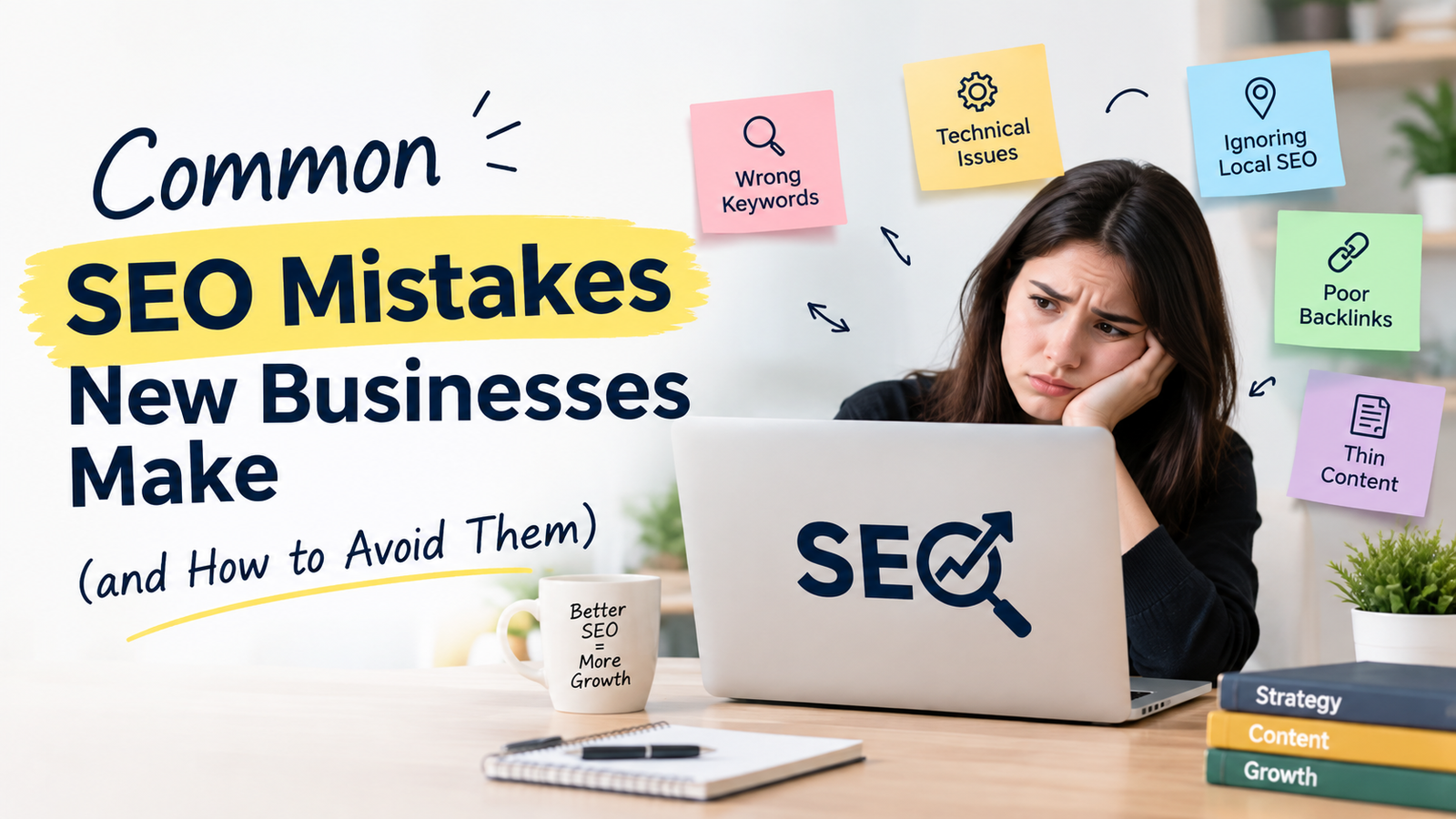
Understanding the common SEO mistakes new businesses make can help you avoid wasted time and build a stronger foundation from the beginning.
Starting a new business is exciting, but getting people to find your business online can be challenging. Common SEO mistakes new businesses make can prevent a new website from getting the visibility, traffic, and customers it deserves.
Many new business owners launch a website, publish a few pages, add some keywords, and expect Google to start sending visitors. When that does not happen, they may assume that SEO is not working.
In reality, the problem is often much simpler.
Small SEO mistakes made during the early stages can make it harder for a new website to build visibility in search results. Some businesses focus too much on keywords, while others overlook technical SEO, local search, content quality, website structure, or what their customers actually need.
The good news is that most common SEO mistakes new businesses make can be identified and fixed.
Here are 20 common SEO mistakes new businesses make and what you can do instead.
1. Treating SEO as an Overnight Strategy
One of the most common SEO mistakes new businesses make is expecting immediate results.
A new website usually needs time to establish its presence. It may have very few pages, limited website history, few backlinks, and no established reputation.
That does not mean SEO is ineffective. It means SEO requires consistent work over time.
Instead of constantly asking:
“How quickly can I rank?”
Ask:
“What can I improve on my website this month?”
Focus on creating useful pages, fixing technical problems, improving existing content, and building a trustworthy online presence.
2. Choosing Keywords Without Understanding Your Customers
Many businesses begin SEO by creating a list of keywords they believe are important.
The problem is that business owners and customers do not always search in the same way.
For example, a business might want to rank for:
“digital marketing services”
But a potential customer might search for:
“digital marketing agency for small business in Delhi”
The second search tells you much more about what the person is looking for.
Before choosing keywords, think about:
- What your customers need
- What problems they are trying to solve
- What services they are looking for
- Where they are located
- Whether they are researching or ready to contact a business
Good keyword research starts with understanding people, not just search volume.
3. Using Keywords Too Many Times
Another common mistake is keyword stuffing.
Some new businesses believe that repeating the same keyword again and again will improve their Google rankings.
For example:
“We are the best SEO agency. Our SEO agency provides SEO services. If you need an SEO agency, contact our SEO agency for SEO services.”
This does not make the page stronger.
Instead, it makes the content difficult to read and can make the business appear less professional.
Use keywords where they naturally fit. Your content should explain the topic clearly and help the reader rather than trying to reach an artificial keyword count.
4. Creating Very Thin Service Pages
A new business may create separate pages for every service but provide only a few sentences on each page.
For example:
SEO Services
“We provide SEO services to help your website rank on Google. Contact us for more information.”
A page like this gives visitors very little reason to trust the company.
A useful service page should explain:
- What the service includes
- Who the service is suitable for
- What problems it can solve
- How the process works
- What customers can expect
- Common questions
- Relevant experience
- How to get started
Your service page does not need to be unnecessarily long.
It needs to be useful.
5. Ignoring Local SEO
If your business serves a specific city or local area, local SEO can be extremely important.
A new business may spend months trying to rank nationally while ignoring potential customers who are searching for its services nearby.
For a local business, check that you have:
- A properly completed Google Business Profile
- Accurate business information
- Consistent contact details
- A clear service area
- Relevant local pages
- Genuine customer reviews
- Relevant local business listings
For example, a digital marketing agency serving Delhi should make its location and services clear instead of expecting Google to figure everything out from a generic homepage.
6. Not Setting Up Google Search Console
Google Search Console is a useful tool for understanding how your website appears in Google Search.
Some new businesses launch their websites and never check it.
As a result, they may miss important information about:
- Search performance
- Indexed pages
- Search queries
- Page indexing problems
- Website experience
- Manual actions
- Sitemap issues
Set up Google Search Console early and check it regularly.
You do not need to spend hours every day studying reports. A regular review can help you identify problems before they become bigger issues.
7. Forgetting About Website Structure
Your website should be easy for both visitors and search engines to navigate.
If important pages are buried several clicks away, or if related pages are not properly connected, your website can become harder to understand.
A simple website structure could look like:
Home → Services → SEO Services → SEO Audit
Your blog content can also connect naturally to relevant service pages.
For example, an article about technical SEO problems could link to your technical SEO service page.
A clear website structure also makes it easier for visitors to find what they need without repeatedly going back to the main menu.
8. Ignoring Internal Links
New businesses often focus on getting backlinks from other websites while forgetting about links they can control themselves.
Internal links connect pages within your own website.
For example:
- An article about keyword research can link to an article about on-page SEO.
- An article about SEO audits can link to your SEO services page.
Useful internal linking can:
- Help visitors discover related content
- Make navigation easier
- Connect related topics
- Help search engines understand your website structure
However, do not add internal links simply to increase the number of links.
Every link should have a clear purpose.
9. Publishing Blog Posts Without a Purpose
Starting a business blog can be a good idea, but publishing random articles every week is not necessarily a good SEO strategy.
Before writing an article, ask:
- Who will read this?
- What problem does it solve?
- What would the reader want to know next?
- Does this topic relate to my business?
For example, a digital marketing company could create content around real problems such as:
- Why your website is not ranking
- Common SEO mistakes
- How to improve local visibility
- Why Google Ads campaigns may not generate leads
- How businesses can improve website conversion rates
These topics are closely connected to the problems potential customers may actually face.
10. Copying Competitors’ Content
Looking at competitors can help you understand what information customers expect.
But copying their content is a different matter.
Your website should have its own explanations, examples, and perspective.
If several competing websites explain the same topic in almost the same way, simply rewriting their sentences will not give your business a strong identity.
Instead, use competitor research to identify gaps.
Ask:
- What useful information are they missing?
- What question have they not answered?
- What can I explain more clearly?
This gives you a better starting point for creating original content.
11. Ignoring Mobile Users
A website can look excellent on a laptop and still be frustrating to use on a phone.
Check your website across different mobile devices.
Pay attention to:
- Text size
- Buttons
- Navigation
- Forms
- Images
- Page spacing
- Loading time
- Contact options
If someone has to zoom in just to read your service page, there is a problem.
Your website should be comfortable and easy to use on smaller screens.
12. Using Poor-Quality or Unoptimised Images
Images can improve your website, but large and poorly optimised images can also slow down your pages.
New businesses sometimes upload very large photographs directly from a camera or phone without optimising them first.
Before uploading an image:
- Resize it appropriately
- Compress the file
- Use a suitable format
- Give the file a meaningful name
- Add descriptive alt text when appropriate
Do not use alt text as a place to stuff keywords.
Describe the image accurately.
13. Ignoring Page Titles and Meta Descriptions
Every important page should have a clear title that tells visitors and search engines what the page is about.
For example:
Poor title:
Home
More useful title:
Digital Marketing Agency in Delhi | DigitalMarkz
The same principle applies to meta descriptions.
Your meta description should clearly explain what someone can expect when they visit the page.
Avoid filling titles and descriptions with multiple versions of the same keyword.
14. Creating Duplicate or Nearly Identical Pages
Some businesses create multiple pages targeting different locations or services but change only a few words.
For example:
- SEO Agency Delhi
- SEO Agency Noida
- SEO Agency Gurgaon
- SEO Agency Faridabad
If all four pages contain almost identical content, they may provide very little additional value to visitors.
If you create location pages, make sure each page contains genuinely useful local information.
The same principle applies to service pages.
Every important page should have a clear reason for existing.
15. Buying Cheap Backlinks
When a new business sees competitors ranking higher, buying hundreds of backlinks can seem like a quick solution.
But this can create more problems than it solves.
Avoid building links simply because someone promises a large number of backlinks for a very low price.
Instead, focus on relevant and trustworthy ways to earn links, such as:
- Useful resources
- Industry publications
- Relevant business directories
- Local organisations
- Partnerships
- Original research
- Expert contributions
A smaller number of relevant links can be more meaningful than a huge collection of unrelated links.
16. Not Building Trust on Your Website
A new business needs to give visitors reasons to trust it.
This becomes particularly important when you are asking someone to spend money on your services.
Make important information easy to find, including:
- About the business
- Contact details
- Services
- Team information
- Business location, where relevant
- Privacy policy
- Terms and conditions
- Genuine customer reviews or testimonials
- Examples of previous work, where appropriate
Avoid claims such as “No. 1 agency” or “Guaranteed Google ranking” unless you can genuinely support them.
Clear and honest information creates a stronger impression.
17. Not Updating Old Content
SEO does not end when an article is published.
Some information becomes outdated over time.
For example, articles about SEO tools, social media features, or digital marketing practices may contain information that changes.
Review important articles periodically and check:
- Facts
- Links
- Examples
- Screenshots
- Recommendations
- Statistics
- Outdated information
When something has changed, update the actual content rather than simply changing the publication date.
18. Measuring Only Rankings
Rankings are useful, but they are not the only thing a business should measure.
For example, a keyword moving from position 20 to position 15 may look positive, but that does not necessarily mean the business is getting more customers.
Also monitor:
- Organic traffic
- Search impressions
- Clicks
- Leads
- Contact form submissions
- Phone enquiries
- Landing-page performance
- Conversions
For most businesses, the purpose of SEO is not simply to collect rankings.
It is to attract the right people and support business growth.
19. Expecting SEO to Fix a Poor Website
SEO can bring people to your website, but it cannot solve every business problem.
If your website is confusing, difficult to navigate, slow, outdated, or unclear about what you sell, more traffic may not produce better results.
Think about the complete customer journey:
Someone searches for your service → They find your page → They visit your website → They decide whether they trust you → They understand your service → They decide whether to contact you.
Every step matters.
20. Not Having a Consistent SEO Plan
Perhaps one of the biggest mistakes new businesses make is working on SEO only when they have time.
One month, they publish five articles.
The next three months, nothing happens.
Then they suddenly build backlinks.
Then they redesign the website.
This makes it difficult to understand what is actually helping.
A simple monthly SEO plan can be more practical:
Week 1: Technical checks
Week 2: Improve existing pages
Week 3: Publish useful content
Week 4: Review performance and plan the next improvements
The exact schedule can vary, but consistency is important.
A Simple SEO Checklist for New Businesses
Before investing heavily in SEO, check the basics.
Website
- Is the website mobile-friendly?
- Does it load properly?
- Is the navigation clear?
- Are important pages indexed?
- Are there broken links?
- Is the website secure?
Content
- Does every important page have a clear purpose?
- Does the content answer customer questions?
- Are keywords used naturally?
- Are service pages detailed enough?
- Is old information updated?
Local SEO
- Is your Google Business Profile complete?
- Is your business information accurate?
- Are customer reviews genuine?
- Is your location clearly mentioned where relevant?
Technical SEO
- Is Google Search Console set up?
- Is your sitemap working correctly?
- Are important pages crawlable?
- Are there indexing problems?
- Are page-speed issues being addressed?
Authority and Trust
- Does your website clearly explain who you are?
- Can visitors easily contact you?
- Are your claims supported?
- Are you earning relevant backlinks?
- Does your content demonstrate genuine experience?
Final Thoughts
By avoiding the common SEO mistakes new businesses make, you can create a website that is easier for search engines and customers to understand.
Usually, the problem is not one single thing. A new website may have weak content, poor keyword targeting, technical problems, weak internal linking, limited local visibility, or simply a lack of consistent effort.
The best approach is to avoid chasing shortcuts.
Build a website that answers real customer questions. Make important information easy to find. Keep your technical foundation healthy. Use keywords naturally. Build genuine trust around your business and review your performance regularly.
SEO works best when it becomes part of your overall digital marketing strategy, rather than something you remember only when your website is not getting traffic.
Start with the basics, fix the problems you can identify, and keep improving.
Over time, those small improvements can create a much stronger foundation for your business in search.