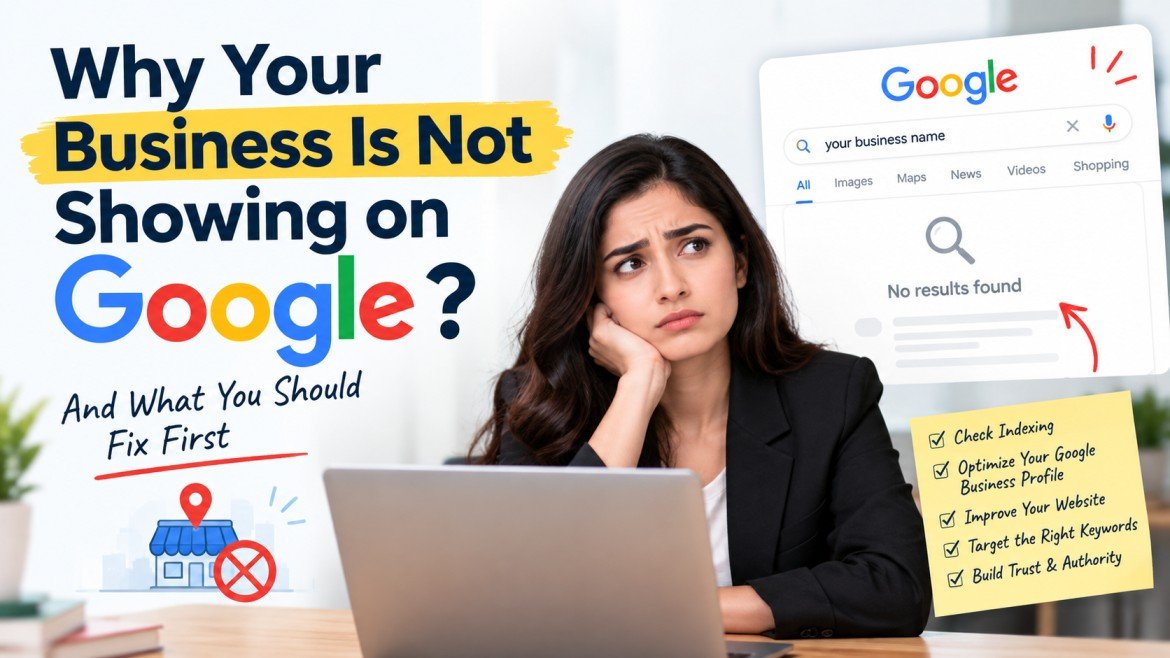
You have a website. Your business is open. Your products or services are ready. But when you search for your business on Google, it is nowhere to be found.
It can be frustrating, especially when competitors seem to appear everywhere.
The good news is that a business not showing on Google does not automatically mean something is seriously wrong. Sometimes Google simply does not have enough information about the business yet. In other cases, the information available online is incomplete, inconsistent, too new, or not strong enough to compete with established businesses.
Understanding the reason is the first step toward fixing the problem.
Here are the most common reasons your business may not be showing on Google and what you can do about them.
1. Your Business Is Still New
If you recently launched your website or created your business listing, do not expect immediate visibility.
Google needs time to discover new websites, understand what they offer, and decide when their pages are useful enough to show in search results.
A new local business also has very little history compared with competitors that may have been operating for several years.
Instead of repeatedly searching for your business every few hours, focus on building a strong foundation.
Make sure your website clearly explains:
-
What your business does
-
Where you operate
-
Who you serve
-
How customers can contact you
-
What makes your services useful
-
Who is behind the business
The clearer this information is, the easier it becomes for both potential customers and search engines to understand your business.
2. Your Google Business Profile Is Incomplete
For businesses serving customers locally, a Google Business Profile can play an important role in appearing on Google Search and Google Maps.
Simply creating a profile is not enough.
Incomplete information can make it difficult for Google and potential customers to understand exactly what your business offers.
Check important details such as your business name, primary category, address or service area, phone number, opening hours, website and services.
Choose the category that most accurately describes your main business activity rather than selecting categories simply because they contain popular terms.
Your profile should represent the real business accurately.
3. Your Business Information Is Inconsistent Online
Imagine finding one phone number for a company on its website and another number somewhere else. Which one would you trust?
The same problem can occur with addresses, business names and opening hours.
If your company recently moved, changed its phone number or updated its name, older information may still exist across business directories and other websites.
Review your major online listings and keep important information consistent.
Pay particular attention to your:
Business name
Address
Phone number
Website
Small formatting differences are not usually the main problem. Major conflicting information, however, can create unnecessary confusion for customers and make your online presence less reliable.
4. Google Cannot Properly Find Your Website Pages
Sometimes the problem is not the business itself. Google may simply have difficulty discovering or accessing important pages on the website.
A quick test is to search:
site:yourwebsite.com
This can give you a rough idea of whether pages from your website are appearing in Google’s search results.
Website owners can also use Google Search Console to check whether important pages have been discovered and indexed.
If an important service page is missing, investigate why instead of immediately creating more content.
The issue could be related to how the website is structured, whether pages are accessible, or whether important pages are properly connected to the rest of the site.
5. Your Website Does Not Clearly Explain What You Do
Visit your homepage and pretend you have never heard of your company.
Within a few seconds, can you understand what the company does and where it provides its services?
If not, the website probably needs clearer content.
Statements such as:
“Delivering Excellence Through Innovative Solutions”
may sound professional, but they tell visitors very little.
Compare that with:
“Residential Plumbing Services in Austin, Texas”
The second statement immediately tells visitors what the company provides and where it operates.
Your website does not need to repeat the same phrase twenty times. It simply needs to communicate its purpose naturally and clearly.
6. You Are Targeting Searches That Are Too Competitive
A small local business may want to rank for a broad search such as:
“best dentist”
But that search can have intense competition.
A dental clinic in Tampa, for example, may have a much better opportunity to establish visibility around searches directly related to its services and location.
Instead of trying to appear for every possible search, build pages around genuine customer needs.
A dental practice might create useful pages covering services such as dental implants, emergency dentistry, teeth whitening and routine dental care, provided those services are actually offered.
Relevance is more valuable than trying to target hundreds of unrelated search terms.
7. Your Website Has Very Little Useful Content
A five-page website is not automatically bad.
The real question is whether those five pages answer the questions potential customers have before contacting the business.
A service page containing only a heading, two sentences and a phone number may leave visitors with many unanswered questions.
A useful service page can explain what the service involves, who it is suitable for, how the process works, what customers should expect, common considerations and frequently asked questions.
Write for the customer first.
If someone finishes reading the page with a clearer understanding of the service, the content is doing its job.
8. Your Website Lacks Signs of Experience and Trust
People want to know who they are dealing with before spending money.
This is especially important for services involving health, finance, legal matters, home repairs and other decisions where choosing the wrong provider can have serious consequences.
Show real information wherever appropriate.
That could include:
-
Your company’s history
-
Team members
-
Professional experience
-
Qualifications or licenses where relevant
-
Genuine customer reviews
-
Real photographs
-
Completed projects or case studies
-
Contact information
-
Business policies
-
Sources for factual claims
This also supports the principles commonly discussed as E-E-A-T: Experience, Expertise, Authoritativeness and Trustworthiness.
E-E-A-T should not be treated as a trick for rankings. Think of it as a reminder to create a website that gives people good reasons to trust the information and the business behind it.
9. You Have Few or No Customer Reviews
Reviews can be particularly valuable for local businesses because customers often compare several companies before making contact.
A company with detailed, recent feedback from genuine customers naturally provides more reassurance than a business with no visible customer experiences.
Ask satisfied customers to leave an honest review.
Never pressure customers to write only positive comments, and avoid purchasing fake reviews.
A small collection of authentic reviews is far more valuable to your reputation than a large collection of suspicious ones.
Respond professionally to reviews as well, including critical feedback. Future customers are often paying attention to how a company handles problems.
10. Your Business Has Very Little Local Presence
If you want customers from a particular city or region, your online presence should make that relationship clear.
Your website should naturally explain where you operate.
Local relevance can also develop through genuine business activity, such as involvement with local organisations, industry associations, events, suppliers, publications and community initiatives.
Do not create dozens of nearly identical city pages simply by changing the city name.
A location page should exist because you genuinely serve that area and can provide useful information to customers there.
11. Other Websites Rarely Mention Your Business
Google does not evaluate your website in complete isolation.
Mentions and links from other relevant websites can help establish that your business is a genuine part of its industry or community.
For example, a local construction company might naturally be mentioned by suppliers, trade associations, local publications or business organisations.
These genuine references are far more meaningful than buying hundreds of links from unrelated websites.
Focus on earning recognition rather than manufacturing it.
12. Your Website Provides a Poor Visitor Experience
Getting someone onto your website is only part of the job.
The site should also be easy to use.
Visitors should not have to struggle with tiny text, confusing menus, intrusive pop-ups or pages that take too long to become usable.
Check your website on an actual mobile phone.
Try to find a service, locate your phone number, read an article and submit your contact form.
If these basic tasks feel difficult, potential customers may experience the same frustration.
A good website should make the next step obvious.
13. Your Website Contains Duplicate or Low-Value Pages
More pages do not automatically mean more Google visibility.
Some websites publish dozens or hundreds of pages that say essentially the same thing.
For example:
“Plumber in City A”
“Plumber in City B”
“Plumber in City C”
If almost everything on those pages is identical apart from the location, they may provide little additional value to users.
Every important page should have a clear purpose.
When creating location or service pages, include information that genuinely matters to customers searching for that specific service or area.
14. You Keep Changing Your SEO Strategy Too Quickly
Search visibility usually develops over time.
One common mistake is changing page titles, content, URLs and target searches every few days because rankings have not immediately improved.
Frequent unnecessary changes make it difficult to understand what is actually working.
Make meaningful improvements, monitor performance and give those improvements enough time to produce useful information.
SEO should be treated as an ongoing business process rather than a one-week campaign.
How to Improve Your Business Visibility on Google
If your business is not appearing where you expect it to, start with the basics before looking for complicated solutions.
Make sure your Google Business Profile accurately represents the business. Check that your important website pages can be found. Clearly explain your services and locations. Publish useful information based on genuine customer questions. Keep business details consistent across important platforms.
Then strengthen the trust surrounding your business through authentic reviews, relevant industry mentions, useful content and transparent information about the people or company behind the website.
Most importantly, measure progress based on meaningful outcomes.
Higher rankings can be useful, but the real objective is attracting people who genuinely need your products or services.
Frequently Asked Questions
Why is my business not showing on Google?
Your business may be new, your Google Business Profile may be incomplete, your website pages may not yet be indexed, or Google may not have enough information to understand the relevance of your business for a particular search.
How long does it take for a business to appear on Google?
There is no universal timeframe. Discovery and visibility can depend on factors such as the website, competition, location, business information and the specific search being performed.
Why does my business appear when I search its name but not its services?
This usually means Google can identify your business by name, but your website or business profile may not yet have enough relevance or prominence to compete strongly for broader service-related searches.
Does a Google Business Profile help with local visibility?
Yes. For eligible local businesses, an accurate and well-maintained Google Business Profile can help customers discover the company through Google Search and Maps.
Can customer reviews help my business?
Genuine customer reviews can strengthen consumer trust and provide useful information about real customer experiences. For local businesses, reviews are also an important part of maintaining a credible Google Business Profile.
Should I create a page for every city I serve?
Not automatically. Create location pages when you genuinely serve those locations and can provide useful, distinct information for customers in each area. Avoid producing large numbers of nearly identical pages simply to target city names.
Final Thoughts
If your business is not showing on Google, do not immediately assume you need more keywords, more pages or a larger advertising budget.
Start by asking a simpler question:
Does Google—and more importantly, a potential customer—clearly understand who we are, what we offer, where we operate and why we can be trusted?
If the answer is unclear, that is where the work should begin.
Build an accurate business presence. Create genuinely helpful pages. Show real experience. Earn authentic reviews and relevant mentions. Keep your information consistent and make your website easy for customers to use.
Google visibility is rarely built through one clever trick.
It grows when your online presence becomes a clear, useful and trustworthy representation of the real business behind it.
I can also prepare an SEO title, meta description, focus keywords, URL slug, FAQ schema questions, and internal-linking plan for this blog.