
Getting a website live is easy. Getting it to rank on Google is a different story.
Many website owners publish blogs, add keywords to their pages, build backlinks and then wait for their rankings to improve. But weeks or even months later, the website is still sitting somewhere on page 5, page 10, or not appearing for important searches at all.
If this sounds familiar, the problem may not be that you need more content or more backlinks. In 2026, Google is much better at understanding whether a page genuinely helps the person searching for an answer.
Google’s current guidance puts strong emphasis on helpful, reliable, people-first content and signals related to experience, expertise, authoritativeness and trust. E-E-A-T itself is not a single ranking factor, but Google uses a combination of signals to identify content that demonstrates these qualities.
So, why is your website not ranking on Google in 2026?
Let’s look at the most common reasons.
1. Your Content Is Not Providing Anything New
One of the biggest problems with websites today is content that simply repeats what is already available online.
For example, suppose you want to rank for “best property management services in India for NRIs.” If your article only explains what property management is, lists a few generic benefits and ends with a sales pitch, it may struggle to compete with established websites.
Google recommends creating content that provides original information, useful analysis, complete answers and substantial value instead of simply rewriting what other websites have already published.
Before publishing an article, ask yourself:
- Does this article answer the actual question?
- Have I included practical information?
- Can I provide examples from real situations?
- Is there something here that competing articles don’t explain properly?
- Would a reader find this useful enough to save or share?
If the answer is no, improving the content should be your first priority.
2. You Are Targeting Keywords That Are Too Competitive
Sometimes the content is good, but the keyword strategy is unrealistic.
A new website trying to rank immediately for a highly competitive keyword such as “digital marketing” or “real estate” is going against websites that have been building authority for years.
This doesn’t mean you should stop targeting competitive keywords. Instead, build your way towards them.
Start with specific long-tail searches that closely match your audience’s needs.
For example:
Instead of:
Digital Marketing
Try:
Digital Marketing Services for Small Businesses in Delhi
Instead of:
Property Management
Try:
NRI Property Management Services in India
Long-tail keywords usually have a more specific search intent, which makes it easier to create a page that directly answers what the visitor wants.
3. Your Search Intent Does Not Match the Keyword
A keyword alone isn’t enough.
You also need to understand why someone is searching for that keyword.
Imagine someone searches:
“How much does property management cost in India?”
They are probably looking for pricing information, factors affecting cost and perhaps examples.
If your page immediately starts selling property management services without answering the pricing question, the visitor may leave quickly.
Before writing a page, search your target keyword on Google and study the results.
Look at:
- What type of pages are ranking?
- Are they guides, service pages, product pages or comparison articles?
- What questions do those pages answer?
- What information is missing?
- What would make your page more useful?
The goal isn’t to copy the top-ranking pages. The goal is to understand what Google believes users are looking for and then provide a better, more useful answer.
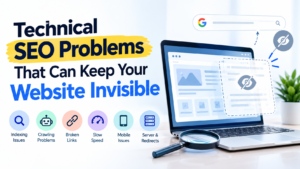
4. Your Website Has Technical SEO Problems
Good content cannot always overcome technical problems.
Your website may have excellent articles, but Google still needs to be able to access, crawl and understand your pages.
Check basic technical issues such as:
- Important pages accidentally blocked from crawling
- Incorrect robots.txt settings
- Noindex tags on pages you want indexed
- Broken internal links
- Incorrect canonical tags
- Duplicate pages
- Poor mobile experience
- Slow-loading pages
- Server errors
- Incorrect redirects
- Missing or poorly configured XML sitemap
Google recommends checking technical requirements and using Search Console to understand how your website is performing in Search.
Google also considers overall page experience, including mobile usability, security and Core Web Vitals. However, good page experience alone does not guarantee high rankings; relevance and usefulness still matter.
5. Google Has Not Indexed Your Page
There is an important difference between not ranking and not being indexed.
If Google has not indexed your page, the page cannot compete in normal organic search results.
You can check this using Google Search Console.
Open:
Search Console → URL Inspection → Enter your URL
There you can check whether Google has discovered and indexed the page.
Also check your sitemap and internal links. A page that is buried deep inside your website and has no useful internal links pointing towards it may be harder for search engines to discover.
6. Your Website Does Not Demonstrate Enough Trust
Trust has become increasingly important, particularly for websites dealing with money, health, legal matters, property or other areas where incorrect information can have serious consequences.
Google’s guidance explains that trust is the most important part of E-E-A-T, while experience, expertise and authoritativeness contribute to establishing that trust.
Your website should make it clear who is behind the content.
Depending on the type of website, this can include:
- A clear About Us page
- Author information
- Relevant professional experience
- Contact information
- Business details
- Real customer reviews
- Case studies
- References or sources where appropriate
- Clear service information
- Updated and accurate information
For example, an article about NRI property management becomes more trustworthy when the company explains its actual experience, services, process and common problems faced by NRI property owners instead of publishing only generic SEO content.
7. You Are Publishing Too Much Low-Quality Content
More blogs do not automatically mean more traffic.
Publishing 50 weak articles won’t necessarily outperform 10 genuinely useful articles.
Google specifically warns against creating large amounts of content primarily to manipulate search rankings. Its spam policies include scaled content abuse when many pages are produced mainly for search manipulation and provide little or no value to users.
This is especially important in 2026 because many websites are producing content at a very high speed.
Instead of asking:
“How many blogs can we publish this month?”
Ask:
“How many genuinely useful pages can we create for our audience?”
Quality and usefulness should come before volume.
8. Your Internal Linking Is Weak
Internal links are often overlooked.
Suppose you have an important service page about NRI property management. You publish several related blogs about tenant management, property inspections, rent collection and property maintenance, but none of those articles link back to the main service page.
You are missing an opportunity.
Create logical connections between related pages.
For example:
Blog: How NRIs Can Manage Rental Property in India
↓
Link to:
Service: NRI Property Management Services in India
Good internal linking helps visitors discover related information and also helps search engines understand how different pages on your website are connected.
9. Your Backlinks Are Weak or Irrelevant
Backlinks still matter, but simply collecting hundreds of links is not a reliable SEO strategy.
A backlink from a relevant and trustworthy website can be much more useful than a large number of random links from low-quality websites.
For example, if you run a property management business, a relevant real estate publication, NRI-focused website or industry resource can make more sense than dozens of unrelated directory links.
Focus on:
- Relevant websites
- Genuine editorial mentions
- Useful guest contributions
- Industry publications
- Digital PR
- Valuable resources that people naturally want to reference
Avoid building links only for the sake of increasing the backlink count.
10. Your Website Is Not Matching What Users Actually Need
Sometimes an SEO audit looks perfect on paper, but the website still doesn’t perform.
Why?
Because SEO isn’t only about keywords, tags and backlinks.
Look at what happens after someone lands on your page.
Can they quickly understand what the page is about?
Can they find the answer without scrolling through unnecessary text?
Is the website easy to use on a phone?
Are there too many pop-ups?
Is the important information buried under advertisements or promotional sections?
Google’s page-experience guidance encourages site owners to provide pages that work well across mobile usability, Core Web Vitals, security and other aspects of the overall experience.
A good SEO page should also be a good page for a real person.
11. You May Be Updating the Wrong Things
Another common mistake is constantly changing titles, publishing dates or adding keywords without understanding why a page isn’t performing.
Changing the date doesn’t automatically make old content fresh.
Google’s guidance specifically warns against changing dates simply to make content appear fresh when the content has not substantially changed.
Instead, update a page when you actually have something useful to add.
For example:
- Add new statistics
- Correct outdated information
- Add new examples
- Improve the explanation
- Add missing questions
- Update screenshots
- Include recent industry changes
- Improve the page structure
That is a meaningful content update.
12. Your SEO Strategy Is Too Focused on Google
This may sound strange, but one of the biggest SEO mistakes is thinking only about Google.
Google’s own guidance says the primary purpose of your content should be to help people, not to manipulate search rankings.
Think about the person who will read the page.
What problem are they trying to solve?
What information do they need before making a decision?
What could make them trust your business?
What questions would they ask if they were speaking to you directly?
Answer those questions properly.
That approach naturally improves many parts of SEO at the same time.
What Should You Do If Your Website Is Not Ranking?
Don’t immediately start publishing more blogs or buying more backlinks.
Start with an SEO audit.
Check these areas one by one:
1. Indexing
Make sure important pages are indexed and accessible to Google.
2. Technical SEO
Check crawlability, redirects, canonical tags, mobile usability, site speed and other technical issues.
3. Search Intent
Make sure every important page matches what users actually want when they search.
4. Content Quality
Remove thin or repetitive content and improve pages that don’t provide enough value.
5. E-E-A-T
Show real experience, expertise, business information, authorship and trustworthy sources where appropriate.
6. Internal Linking
Connect related blogs, category pages and important service pages.
7. Backlink Profile
Focus on relevant and genuine links instead of chasing large numbers.
8. Search Console Data
Look at impressions, clicks, queries, indexing issues and pages that are gaining or losing visibility.
Final Thoughts
If your website isn’t ranking on Google in 2026, the answer isn’t always “you need more backlinks” or “you need more keywords.”
Search has become more competitive, and websites need to provide a clear reason for users to choose their content.
The strongest approach is to build useful pages around real customer questions, demonstrate genuine experience, maintain a technically healthy website and earn trust over time.
SEO is not a one-week activity. A website usually needs consistent improvements, testing and patience before you can understand which changes are actually moving the needle.
Most importantly, don’t create a page just because you found a keyword with search volume.
Create it because you have something genuinely useful to say.
That is the kind of SEO strategy that can continue to work in 2026 and beyond.