SEO vs AEO vs GEO is becoming an important topic for businesses in 2026. Search is changing, and the way people discover businesses, ask questions, compare services, and find information online is changing with it.
For years, SEO was the main way businesses tried to get their websites discovered on Google. The basic approach was familiar: choose relevant keywords, create useful pages, improve technical SEO, build authority, and work towards better organic rankings.
But search behaviour is no longer limited to traditional search results.
People now ask direct questions, look for quick answers, compare products and services, research businesses, and use different search experiences to find what they need.
Because of this, businesses are hearing three terms more often:
- SEO – Search Engine Optimisation
- AEO – Answer Engine Optimisation
- GEO – Generative Engine Optimisation
These terms are related, but they are not exactly the same.
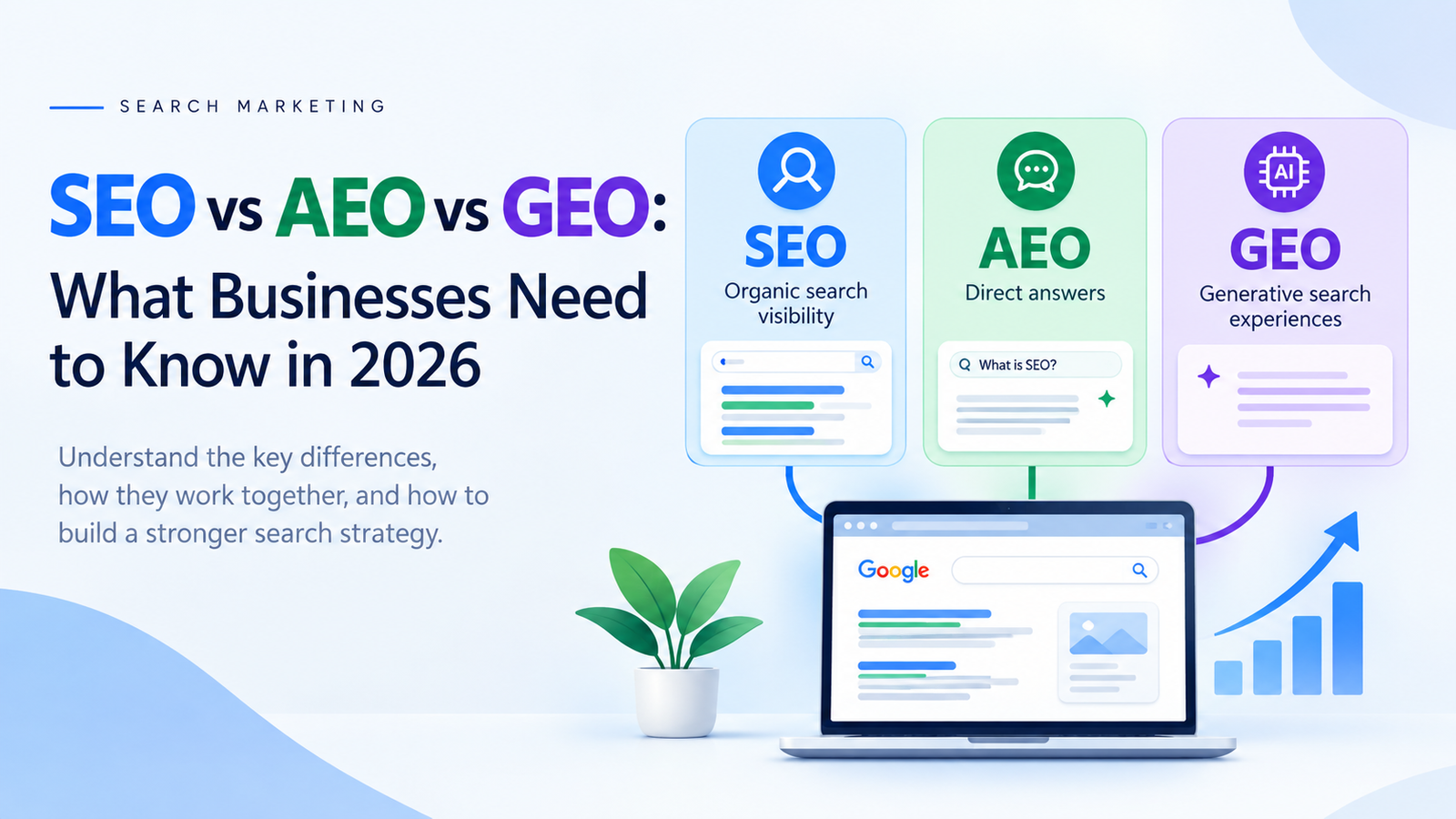
SEO focuses mainly on improving a website’s visibility in search engines. AEO focuses on making content useful for direct answers and question-based searches. GEO focuses on improving how a business or its content may be discovered and referenced in generative search experiences.
The important point is that businesses do not necessarily need to choose one and ignore the others.
A strong search strategy in 2026 can bring these approaches together.
What Is SEO?
SEO stands for Search Engine Optimisation.
It is the process of improving a website so that search engines can understand its pages and users can find useful information through organic search.
SEO covers several important areas, including:
- Keyword research
- Search intent
- On-page SEO
- Technical SEO
- Internal linking
- Content quality
- Website structure
- Backlinks and online authority
- Local SEO
- Mobile experience
- Page performance
For example, suppose you run a digital marketing agency in Delhi.
You may want your website to appear when someone searches for:
“digital marketing agency in Delhi”
Your service page needs to clearly explain what you offer, who you help, where you operate, and why someone should consider contacting you.
At the same time, your website should have a technically sound structure and useful supporting content.
That is traditional SEO thinking.
What Is AEO?
AEO stands for Answer Engine Optimisation.
The focus is slightly different.
Instead of thinking only about ranking for a keyword, AEO asks:
Can my content clearly answer the question a person is asking?
People often search using questions such as:
- What is technical SEO?
- How does local SEO work?
- What are the different types of backlinks?
- How much does SEO cost?
- How long does SEO take?
- Why is my website not ranking on Google?
AEO encourages businesses to structure content so that important questions are answered clearly and directly.
This does not mean writing extremely short answers.
A good page can give a direct answer first and then explain the subject in greater depth.
What Is Technical SEO?
Technical SEO focuses on the technical parts of a website that help search engines crawl, understand, and index its pages properly.
After that short explanation, the page can discuss crawling, indexing, redirects, canonical URLs, site speed, mobile usability, and other relevant areas.
This structure helps the reader find the answer quickly while still giving them enough information to understand the subject.
What Is GEO?
GEO is commonly used to mean Generative Engine Optimisation.
The idea is to improve the way a business’s information can be discovered, understood, and potentially referenced within generative search experiences.
This changes the way businesses think about content.
Traditional SEO often asks:
“How can I rank this page?”
GEO adds another question:
“How can I make this information clear, useful, trustworthy, and easy for a search system to understand?”
For a business, this can mean creating genuinely useful information rather than publishing pages simply to target keywords.
Clear explanations, original information, accurate business details, strong topical coverage, and credible references can all contribute to making a website easier to understand.
GEO should not be treated as a magic formula or a separate shortcut to visibility.
It is better understood as an extension of good content and search practices for newer search experiences.
SEO vs AEO vs GEO: What’s the Difference?
The simplest way to understand SEO vs AEO vs GEO is to look at their primary focus.
| Approach | Main Focus | Typical User Behaviour |
|---|---|---|
| SEO | Organic search visibility | Searches and visits websites |
| AEO | Direct answers | Asks specific questions |
| GEO | Visibility in generative search experiences | Wants a researched or summarised answer |
There is some overlap between them.
A technically strong website helps SEO, AEO, and GEO.
Useful content helps all three.
Clear information helps all three.
Strong authority and trustworthy information can support all three.
Understanding SEO vs AEO vs GEO helps businesses create a more complete search strategy instead of focusing only on traditional rankings.
That is why businesses should not build three completely separate strategies.
SEO vs AEO vs GEO: Why SEO Is Still the Foundation
The rise of AEO and GEO does not make SEO irrelevant.
A website still needs to be accessible, crawlable, and properly structured.
Important pages need to be discoverable. Content needs to be useful. Internal links should help users and search engines move through the website. Pages should work properly on mobile devices.
If the basic website foundation is weak, adding new content formats will not solve the underlying problem.
For example, a company may publish dozens of detailed articles about its services.
But if important pages are blocked from crawling, poorly linked, or affected by technical problems, the business may still struggle to gain meaningful visibility.
This is why technical SEO remains an important part of the overall strategy.
SEO vs AEO vs GEO: How AEO Starts With Questions
AEO becomes particularly useful when businesses understand the questions their customers actually ask.
Think beyond individual keywords.
A potential customer might not search only for:
“SEO agency Delhi”
They may also ask:
- What does an SEO agency do?
- How much does SEO cost in Delhi?
- How long does SEO take to show results?
- What should I check before hiring an SEO agency?
- Is SEO useful for a small business?
- What is the difference between SEO and digital marketing?
These questions reveal something about the customer’s concerns.
They also give businesses opportunities to create helpful content.
Instead of publishing another generic article titled “Benefits of SEO,” a company can answer a specific question that its potential customers genuinely want to understand.
GEO Makes Content Quality Even More Important
Generative search experiences can change how people consume information.
Instead of opening several search results and reading each page, a user may first see a response that brings information together.
For businesses, this means simply mentioning a keyword repeatedly is not enough.
Content needs substance.
A useful business article should make it easy to understand:
- What the topic means
- Why it matters
- Who it applies to
- What mistakes to avoid
- What steps someone can take
- What limitations or exceptions exist
- When professional help may be useful
The goal is not to write for a machine.
The goal is to create information that is genuinely useful to the person reading it.
Clear, useful content is also easier for search systems to interpret.
E-E-A-T Matters Across SEO, AEO and GEO
E-E-A-T stands for:
Experience, Expertise, Authoritativeness, and Trustworthiness.
For businesses creating search-focused content, these principles are important regardless of whether the goal is SEO, AEO, or GEO.
Experience
Where appropriate, content should reflect real experience.
For example, a digital marketing agency can explain what businesses commonly need to check before starting an SEO campaign.
But businesses should avoid inventing case studies, results, or client experiences simply to make an article sound authoritative.
Expertise
Content should demonstrate a proper understanding of the subject.
If you are explaining technical SEO, for example, the article should explain concepts accurately rather than simply repeating definitions from other websites.
Authoritativeness
A website becomes stronger when its business information, authorship, references, and overall online presence support what it publishes.
Relevant industry mentions and genuine recognition can contribute to this.
Trustworthiness
Trust is especially important when someone is considering buying a service.
A business website should clearly communicate:
- Who the company is
- What services it provides
- How customers can contact it
- Where it operates
- What the service includes
- What customers can realistically expect
Trust is not created by adding a few marketing phrases to a page.
It is built through consistent and transparent information.
How Businesses Should Create Content in 2026
One of the biggest mistakes businesses can make is treating SEO, AEO, and GEO as three separate content calendars.
You do not necessarily need:
- One blog for SEO
- Another blog for AEO
- Another blog for GEO
Instead, start with the customer’s problem.
Suppose you run a web development company.
Your customer may have questions such as:
- Why is my website slow?
- How much does a business website cost?
- What should a good business website include?
- Should I choose WordPress or custom development?
Each question can become a useful piece of content.
Within that content, you can naturally include relevant keywords, answer common questions, explain the subject properly, and demonstrate your expertise.
That single piece of content can support several aspects of your search strategy.
Build Topic Depth Instead of Publishing Random Articles
A website with 100 unrelated blog posts is not necessarily more useful than a website with 30 well-planned articles.
Imagine a business provides SEO services.
Instead of publishing random topics every week, it could build a content group around SEO.
Main Topic: SEO
Supporting topics could include:
- What is SEO?
- Types of SEO
- On-page SEO
- Technical SEO
- Off-page SEO
- Local SEO
- Keyword research
- Search intent
- Internal linking
- Backlinks
- Anchor text
- Google Search Console
- Common SEO mistakes
These pages can connect naturally through internal links.
This gives visitors a clearer path through the website and helps the business demonstrate knowledge across an entire subject.
Don’t Forget the Human Reader
A common mistake in search-focused content is writing for visibility while forgetting the person reading the page.
A customer does not care whether a paragraph contains a keyword three times.
They care about getting a useful answer.
They want to know:
- Can this business solve my problem?
- Does this company understand my situation?
- Can I trust the information?
- What should I do next?
Good content should answer these questions naturally.
If the article is difficult to read, full of unnecessary terminology, or written only around keywords, visitors may leave even if the page gets traffic.
That is why content quality and conversion should be considered together.
SEO vs AEO vs GEO: How They Work Together
A practical 2026 strategy can look like this:
Step 1: Start With SEO
Make sure the website has a strong technical foundation.
Check:
- Indexing
- Crawlability
- Internal links
- Page structure
- Mobile usability
- Page performance
- URLs
- Redirects
- XML sitemap
Step 2: Understand Search Intent
Before creating content, understand what the person actually wants.
Are they:
- Looking for information?
- Comparing options?
- Trying to solve a problem?
- Ready to contact a business?
The answer affects the type of page you should create.
Step 3: Add Direct Answers
Look at the questions customers ask.
Answer important questions clearly within your service pages, guides, FAQs, and blog articles.
Step 4: Build Useful Supporting Content
Cover related questions and problems instead of repeatedly writing about the same subject.
Create content that adds something useful to the website.
Step 5: Strengthen Trust
Keep company information accurate and easy to verify.
Use clear authorship where appropriate, explain services honestly, and support important claims with reliable sources when needed.
Step 6: Connect Your Content
Use internal links to connect related pages.
A visitor reading about keyword research should be able to move naturally to content about:
- Search intent
- On-page SEO
- Technical SEO
- Internal linking
- Backlinks
This creates a better experience for the reader and helps visitors discover more useful information on your website.
Step 7: Measure What Matters
Do not judge the entire strategy only by rankings.
Look at:
- Organic traffic
- Relevant search queries
- Search visibility
- Engagement
- Leads
- Contact enquiries
- Calls
- Form submissions
- Sales opportunities
The purpose of search visibility is not simply to collect impressions.
It should help the right people discover your business.
Common SEO, AEO and GEO Mistakes Businesses Should Avoid
1. Treating AEO as a Keyword Trick
Simply adding question headings to every page does not automatically make content useful.
The answer underneath the heading matters.
2. Treating GEO as a Shortcut
There is no simple formula that guarantees a business will be mentioned in every generative search experience.
Focus on useful, accurate, and trustworthy information instead.
3. Ignoring Traditional SEO
New search experiences do not remove the need for a technically healthy website.
Your website foundation still matters.
4. Publishing Large Amounts of Similar Content
Creating multiple articles around almost identical topics can make the website harder to manage and may provide little additional value to users.
5. Writing Without Understanding Customers
A keyword may have search volume, but that does not automatically mean the traffic will be valuable for your business.
Always consider both search intent and business relevance.
6. Making Unsupported Claims
Avoid statements such as:
“Guaranteed Google rankings.”
Or other unrealistic promises.
Trust is difficult to build and easy to lose.
7. Forgetting Conversion
A business can receive visitors without receiving enquiries.
Search visibility should ultimately connect with:
- A useful website experience
- Clear service information
- Strong trust signals
- An obvious next step
SEO vs AEO vs GEO: What Should Businesses Focus on in 2026?
The answer is not to abandon SEO and chase every new search trend.
Instead, businesses should build a stronger overall search presence.
Think of SEO vs AEO vs GEO this way:
SEO helps people discover your website.
AEO helps your content answer their questions clearly.
GEO focuses attention on how your information may be surfaced in generative search experiences.
These areas overlap, and a good strategy can support all three.
Businesses that take content seriously can build a stronger foundation than those that simply keep publishing pages without a clear purpose.
SEO vs AEO vs GEO: Final Thoughts: Final Thoughts
SEO, AEO, and GEO are not three completely separate worlds.
They represent different ways people may discover and consume information.
For businesses in 2026, the practical approach is straightforward:
- Build a technically strong website
- Understand what customers are searching for
- Answer their questions properly
- Create useful and trustworthy content
- Connect related information
- Keep the focus on the people you want to reach
Search may continue to change, but one principle remains important:
Create information that is genuinely useful to your audience, and build your website so that people can find, understand, and act on it.
That is a much stronger foundation than trying to chase every new search trend.