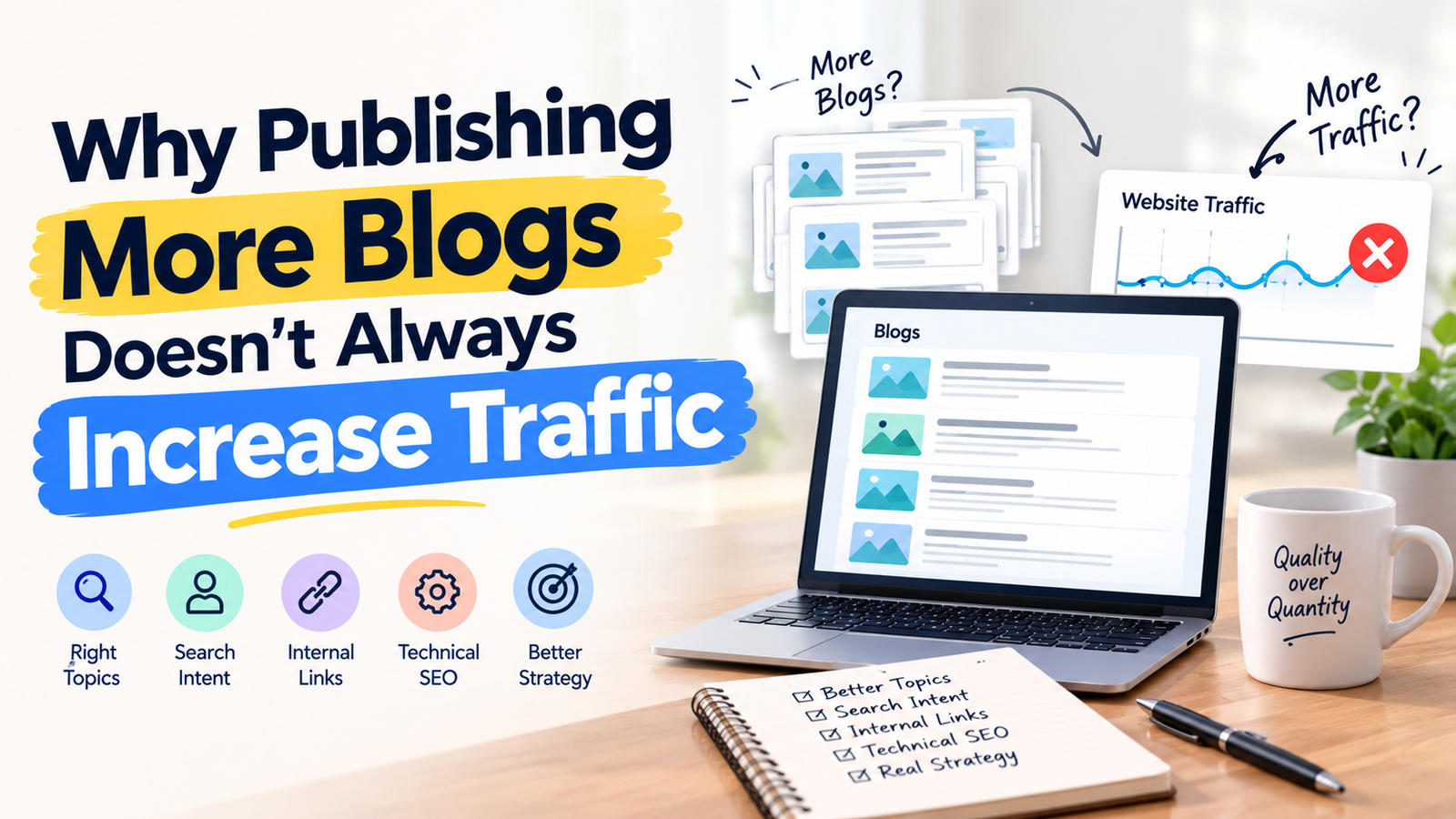
Publishing more blog posts can feel like the obvious way to get more website traffic.
If one article brings visitors, it is easy to assume that publishing ten more will bring even more people to your website.
But SEO does not work that simply.
A website can publish new articles every week and still see very little growth in organic traffic. In some cases, the problem is not the amount of content at all.
Perhaps the existing articles are targeting topics that people rarely search for. Maybe they do not properly answer the reader’s question. Your content could also be difficult for search engines or visitors to discover.
That is why the number of blog posts should not be the only thing you measure.
A better question is:
Are your blogs giving the right people a useful reason to visit your website?
Let’s look at why publishing more blogs does not always lead to more traffic and what you can do instead.
17 Reasons Publishing More Blogs Doesn’t Always Increase Traffic
1. You May Be Publishing Topics Nobody Is Searching For
The first problem can appear before you even start writing.
A topic may sound interesting to you but have very little demand from your target audience.
For example, a digital marketing agency could publish an article called:
“Our Favourite Digital Marketing Techniques”
The article might be well written. However, if potential customers are not searching for that information, there may be very little opportunity to attract organic traffic.
Now compare it with a problem-based topic:
“Why Is My Website Getting Traffic but No Leads?”
That second topic addresses a problem that a business owner may actively want to solve.
Before creating another article, ask yourself:
- Is this a real question from my audience?
- Does the topic solve a genuine problem?
- Is there a reason someone would search for it?
- Does it connect naturally with my products or services?
The answers can tell you whether another blog is actually worth creating.
2. You Keep Writing About the Same Subject
Publishing frequently can sometimes create another problem: repetition.
A website might have articles such as:
- How to Improve SEO
- Best SEO Tips
- SEO Tips for Better Rankings
- How to Get Better Google Rankings
- Ways to Improve Your SEO
The titles are different, but the actual articles may answer almost the same question.
Adding another similar post will not necessarily give your audience something new.
Instead, look at what you already have.
Could an existing article be expanded?
Would several related questions work better inside one stronger resource?
Are two overlapping articles competing for the same audience?
Sometimes, improving one useful article is more valuable than publishing another version of the same topic.
More URLs do not automatically mean more useful content.
3. Search Intent Is Being Ignored
People search Google for different reasons.
Someone searching:
“What is technical SEO?”
is probably looking for an explanation.
On the other hand, a person searching:
“Technical SEO audit service”
may be looking for a company that provides the service.
If your article does not match the reason behind the search, it may struggle to satisfy the visitor.
Before writing, think about what the person actually wants after typing the search query.
Do they want:
- An explanation?
- Instructions?
- Examples?
- A comparison?
- A solution?
- A service?
- A product?
Once you understand the search intent, planning the article becomes much easier.
The goal is not simply to rank for a keyword. Your content should give the searcher what they expected to find.
4. Your Articles Are Too Broad
Broad topics can be difficult for smaller websites to compete with.
Consider a topic such as:
“Digital Marketing”
It covers an enormous subject and could attract people with completely different needs.
A more specific topic could be:
“Digital Marketing Strategies for Local Service Businesses”
That version gives you a clearer audience and a more specific problem to address.
This does not mean broad topics should never be published.
Instead, your content strategy should also include specific subjects that closely match the questions your potential customers are asking.
Specific content can help you build relevance around the services and problems that matter to your business.
5. You Are Writing for Keywords Instead of People
Keyword research is useful.
However, an article should not feel like it was written simply to repeat a phrase as many times as possible.
For example, if your target phrase is “technical SEO problems,” there is no need to force that exact phrase into every heading and paragraph.
Write naturally.
Use related terms where they make sense. Explain the subject properly. Make the information easy for someone to understand.
When readers can quickly understand your article and find the answer they need, you are creating something more useful than a page filled with repeated keywords.
SEO should help people find your content. It should not make the content difficult to read.
6. Your New Blog Is Not Better Than Existing Results
Before publishing another article, ask yourself one simple question:
Why should someone choose this article?
There are already countless articles covering popular SEO and digital marketing topics.
If your article says exactly the same things as dozens of other websites, adds no useful examples, and does not answer the reader’s questions more clearly, publishing it may not create much additional value.
Look for ways to make the information more useful.
You could include:
- A practical process
- Common mistakes
- Real questions customers ask
- Clear examples
- A useful checklist
- Screenshots where appropriate
- Different situations and their possible solutions
Only include experience-based information that you can genuinely support.
Avoid creating fake client stories or invented results just to make an article appear more authoritative.
Useful content does not need exaggerated claims.
7. Your Existing Articles May Need Updating
Sometimes the answer to low traffic is not another blog post.
An older article may simply need attention.
Open your existing posts and ask:
- Is the information still accurate?
- Are the examples outdated?
- Are important questions missing?
- Are the links still working?
- Does the title accurately describe the article?
- Does the content still match the search intent?
- Could the introduction be clearer?
An article that already receives some impressions or clicks may be worth improving instead of leaving it untouched while you publish another ten posts.
Updating existing content can also reveal opportunities for better internal links, clearer explanations, and stronger coverage of related questions.
Before creating something new, check whether you already have a page that could become much better.
8. You Are Ignoring Internal Links
A new blog should not sit alone on your website.
Connect it with other relevant pages so readers can continue exploring useful information.
For example, a technical SEO article could naturally link to content about:
- On-page SEO
- SEO audits
- Backlinks
- Anchor text
- Website indexing
- Common SEO mistakes
These connections give readers an easier way to discover related subjects.
They also help create a logical structure across your website.
Think of your blog section as a connected library rather than a collection of separate pages.
When you publish a new article, look for older relevant pages that could naturally link to it.
9. Your Website Has Technical SEO Problems
Sometimes the problem has nothing to do with your publishing schedule.
You could publish excellent articles and still struggle if important pages cannot be properly accessed, crawled, or indexed.
Technical problems can include:
- Incorrect noindex settings
- Robots.txt problems
- Broken internal links
- Incorrect canonical tags
- Redirect problems
- Poor website structure
- Slow pages
- Mobile usability problems
- Sitemap issues
Before increasing your publishing frequency, make sure search engines can properly access the content you already have.
There is little value in continuously creating new pages if technical problems are preventing important content from performing properly.
10. Your Content Is Not Connected to Your Business
A business blog should have a purpose.
That does not mean every article needs to aggressively sell something.
Your topics should, however, make sense for the audience you want to attract.
For a digital marketing agency, useful subjects might include:
- SEO
- Website performance
- Lead generation
- Google Ads
- Social media marketing
- Conversion problems
- Website visibility
- Digital marketing strategies
These topics can naturally connect with the services the agency provides.
Publishing completely unrelated topics simply because they appear to have search volume may bring visitors who have no reason to become customers.
Traffic becomes more useful when it comes from people who are relevant to your business.
11. Your Headlines Are Not Clear Enough
Your headline is often one of the first things a searcher sees.
A vague title can make the purpose of an article difficult to understand.
Compare these two examples:
“Website SEO Guide”
and
“Technical SEO Problems That Can Keep Your Website Invisible”
The second title immediately communicates the problem the article addresses.
A strong headline should be clear and accurate.
Avoid making promises that the article does not deliver.
Your title should give readers a good idea of what they will learn before they click.
12. You Are Not Looking at Search Data
Once an article is published, its performance can provide useful information.
An article may begin appearing for searches that you did not originally target.
Those search queries can reveal what readers actually want to know.
Google Search Console can help you review queries, impressions, clicks, and other search performance information associated with your pages.
For example, imagine that your article targets:
“technical SEO audit”
but also receives impressions for:
- Technical SEO checklist
- Technical SEO audit tools
- How to find technical SEO issues
Instead of immediately creating three new articles, review the existing page.
Could these questions be answered more clearly inside the current article?
Sometimes the search data is telling you that an existing page has room to become more useful.
13. You Are Publishing Too Quickly
There is nothing wrong with having a publishing schedule.
The problem starts when the schedule becomes more important than the quality of the content.
Imagine a team deciding:
“We must publish five blogs every week.”
What happens if there are only two genuinely useful topics that week?
The pressure to reach the number can lead to repetitive, shallow, or rushed articles.
A realistic publishing schedule gives writers enough time to research, write, edit, improve, and fact-check each article.
You do not necessarily need to publish five posts every week.
One genuinely useful article can have a clearer purpose than several rushed posts.
14. You Are Not Promoting or Connecting Your Content
Publishing an article is not always the end of the process.
Once the article goes live, make sure the relevant parts of your website point toward it.
You can:
- Add internal links from older articles
- Link to it from relevant service pages
- Include it in a related-post section
- Share it through appropriate business channels
- Mention it when answering relevant customer questions
The right promotion method depends on your audience, industry, and business.
What matters is that a new article should not be forgotten immediately after publication.
Give useful content opportunities to be discovered.
15. Your Content Does Not Answer the Next Question
A useful article should answer the main question.
It should also consider what the reader is likely to ask next.
For example, someone reading:
“What Is Technical SEO?”
may naturally want to know:
- What problems does technical SEO fix?
- How can I find those problems?
- Which tools can I use?
- How often should I check my website?
- What should I fix first?
When an article answers these related questions clearly, it becomes more useful to the reader.
You do not need to make every article extremely long.
The goal is to make the article complete enough for its purpose.
Focus on usefulness rather than adding words simply to increase the word count.
16. You May Have Orphan Content
An orphan page has few or no useful internal links from other parts of your website.
Imagine publishing a detailed guide and then never linking to it again.
Even if the article is excellent, it can become disconnected from the rest of your website.
Review your older articles and look for places where the new article can genuinely add value.
At the same time, add links from the new article to your strongest relevant resources.
This creates connections between related content instead of leaving every blog as an isolated page.
17. You Are Measuring Success Only by Traffic
Traffic is important, but it is not the only thing that matters.
Consider two hypothetical articles.
Article A
- 3,000 visitors
- Very broad audience
- Almost no enquiries
Article B
- 500 visitors
- Highly relevant business audience
- Several genuine enquiries
For a service business, the second article may support the business goal more directly even though it receives fewer visitors.
That is why you should also consider:
- Relevant visitors
- Enquiries
- Contact-form submissions
- Phone calls
- Service-page visits
- Engagement with important pages
Your measurement should match your actual business objective.
If the purpose of your content is to generate qualified enquiries, traffic alone cannot tell you whether the strategy is working.
What Should You Do Instead of Simply Publishing More Blogs?
If your website already has a large collection of articles, pause before adding another one.
Start by reviewing what you already have.
Step 1: Find Your Strongest Articles
Look for pages that already receive impressions, clicks, or relevant visitors.
These pages can reveal what your audience and search engines already find useful.
Step 2: Find Content Gaps
Identify important questions that your audience still cannot answer from your website.
Those gaps can become opportunities for genuinely useful new content.
Step 3: Find Overlapping Articles
Look for pages that cover almost the same subject.
Some topics may work better as one comprehensive resource rather than several smaller articles.
Step 4: Improve Useful Existing Content
Update outdated sections, add missing information, improve clarity, and make sure the article still satisfies the search intent.
An existing page with some visibility may deserve attention before you create another URL.
Step 5: Build Internal Links
Connect related articles with useful internal links.
Also link important blog content with relevant service pages when the connection makes sense.
Step 6: Check Technical Issues
Make sure important content can be accessed, crawled, and indexed properly.
Technical problems can limit the value of content that you have already spent time creating.
Step 7: Create New Content Only When There Is a Clear Reason
A new article should fill a genuine gap.
Do not create another post simply because your monthly blog count looks too low.
The question should be whether the new content adds something useful that your existing website does not already provide.
A Better Way to Think About Blog Publishing
Instead of asking:
“How many blogs should we publish this month?”
ask:
“What useful information does our audience need that we have not covered properly?”
That small change can completely improve the way you plan your content.
Your website might need another blog.
Or it might need:
- A better service page
- An updated article
- Stronger internal links
- A technical SEO fix
- A clearer title
- Better search-intent alignment
- A more useful content structure
The right answer depends on what your website is currently missing.
Final Thoughts
Publishing more blogs can help you build a larger content library, but the number of articles alone does not guarantee more organic traffic.
If your website is publishing regularly but traffic is not growing, look beyond your publishing schedule.
Check the topics you are choosing.
Look at search intent.
Review your existing articles.
Find overlapping content.
Improve useful pages.
Strengthen internal links.
Check technical SEO.
Most importantly, make sure the content is genuinely useful to the people you want to reach.
The goal is not to have the biggest blog archive.
The goal is to build a website where every important page has a clear purpose and gives the reader something genuinely useful.
Featured Image Alt Text:
Why publishing more blogs doesn’t always increase traffic