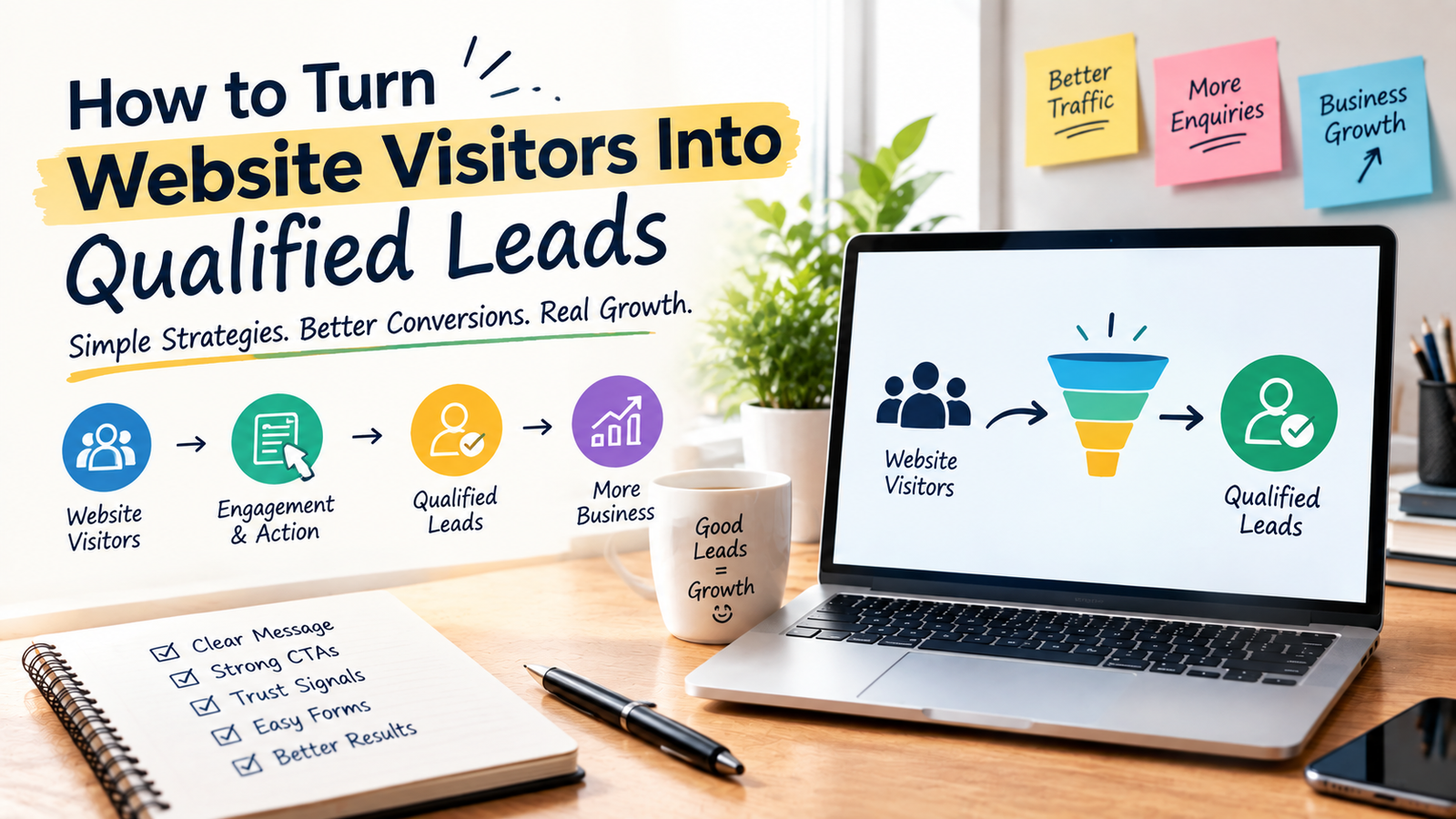
How to turn website visitors into qualified leads is one of the biggest challenges for businesses that rely on their website for enquiries and sales. Getting visitors to your website is important, but traffic alone does not guarantee business. If people visit your website and leave without contacting you, requesting a quote, or showing interest in your service, something in your conversion journey may be missing.
In this guide, we’ll look at practical ways to turn more website visitors into qualified leads, from improving your messaging and calls-to-action to building trust and making it easier for people to contact your business.
Getting people to visit your website is only the first step. The real challenge is getting the right visitors to take action, share their details, and show genuine interest in what your business offers.
If your website gets traffic but very few enquiries, you may not have a traffic problem. You may have a conversion problem.
In this guide, we’ll explain how to turn website visitors into qualified leads using practical changes that make your website easier to understand, more trustworthy, and more focused on getting enquiries. You’ll learn what to fix, what to track, and how to turn more of your existing traffic into real business opportunities.
What Is a Qualified Lead?
Before learning how to turn website visitors into qualified leads, it is important to understand what a qualified lead actually means.
A website visitor becomes a lead when they take an action that gives you a way to contact them. This could be:
- Filling out a contact form
- Calling your business
- Sending a WhatsApp message
- Booking a consultation
- Requesting a quotation
- Signing up for a service
- Downloading useful information
- Asking about pricing
But not every lead is a qualified lead.
For example, someone who fills out your form just to ask a random question may not be ready to buy.
A qualified lead is someone who has a genuine need for your product or service and has a reasonable chance of becoming a customer.
That difference matters.
Why Website Visitors Don’t Become Qualified Leads
You can have hundreds or even thousands of visitors every month and still receive very few enquiries.
This usually happens because visitors don’t immediately find what they need.
They may be asking:
- What does this business actually offer?
- Can they solve my problem?
- How much does it cost?
- Can I trust them?
- What should I do next?
- Why should I choose them instead of another company?
If your website doesn’t answer these questions clearly, visitors have little reason to contact you.
That’s why how to turn website visitors into qualified leads is not simply about adding more traffic.
It is about making better use of the traffic you already have.
1. Make Your Main Message Clear Immediately
When someone lands on your website, they shouldn’t have to spend 30 seconds figuring out what you do.
Your homepage should quickly communicate:
What you offer + who you help + why it matters + what the visitor should do next.
For example, instead of saying:
“We deliver innovative digital solutions for modern businesses.”
You could say:
“We help small businesses generate more leads through SEO, Google Ads and conversion-focused websites.”
The second version is easier to understand.
A visitor knows what you do and what they can expect.
If people understand your offer quickly, you’re already one step closer to turning them into leads.
2. Speak About the Customer’s Problem
One common website mistake is talking too much about the company.
Visitors are usually more interested in their own problem.
Instead of starting with:
“We are a leading digital marketing company with years of experience…”
Try starting with the problem you solve:
“Not getting enough enquiries from Google? We help businesses improve their online visibility and turn website traffic into genuine leads.”
This immediately creates relevance.
When your website reflects what the visitor is already thinking about, they are more likely to continue reading.
3. Give Visitors a Clear Reason to Contact You
If you want to learn how to turn website visitors into qualified leads, pay close attention to your call-to-action.
A website visitor should never have to wonder:
“What am I supposed to do now?”
Your CTA should be simple and specific.
Examples include:
- Get a Free Consultation
- Request a Quote
- Talk to an Expert
- Get Your Free Website Audit
- Book a Consultation
- Send Us a WhatsApp Message
- Get Started Today
Avoid using the same generic button everywhere, such as:
“Click Here”
Tell people what happens when they click.
A clear CTA reduces hesitation and makes the next step easier.
4. Build Trust Before Asking for the Lead
People don’t give their contact details to a business they don’t trust.
This is especially important when your service is expensive or requires a long-term relationship.
Your website should give visitors enough reasons to believe that you’re genuine.
Useful trust elements include:
- Customer testimonials
- Reviews
- Case studies
- Client logos
- Before-and-after results
- Awards or certifications
- Industry experience
- Team information
- Real business photographs
- Clear contact information
- Secure payment or enquiry processes where relevant
Don’t simply say:
“We are the best.”
Show people why they should trust you.
A real case study explaining a client’s problem, what you did, and what changed can be far more convincing than a long list of marketing claims.
5. Create Landing Pages That Generate Qualified Leads
Sending every visitor to your homepage isn’t always the best approach.
Different visitors have different needs.
For example, if you provide digital marketing services, you could create separate pages for:
- SEO Services
- Google Ads
- Meta Ads
- Website Development
- Local SEO
- AEO
- E-commerce Marketing
Someone searching specifically for SEO should land on a page that talks directly about SEO.
This makes the visitor’s journey much easier.
A relevant landing page can explain:
- The problem
- Your solution
- How your service works
- Why they should trust you
- What results they can expect
- Frequently asked questions
- The next step
This is a much stronger path from search to enquiry.
6. Make Your Website Easy to Use
Good design isn’t just about making a website look attractive.
It should make it easy for people to find information and take action.
Check your website on both desktop and mobile.
Look at:
- Page loading speed
- Font size
- Button visibility
- Navigation
- Contact forms
- Mobile layout
- Image quality
- Broken links
- Pop-ups
- Checkout or booking process
If a visitor has to struggle to complete a simple action, there’s a good chance you’ll lose the lead.
A simple website that guides people clearly can often perform better than a beautiful website that makes visitors work too hard.
7. Don’t Ask for Too Much Information
Long forms can discourage people from contacting you.
Imagine a visitor wants to request a consultation, but your form asks for:
- Full name
- Company name
- Job title
- Address
- Phone number
- Website
- Monthly revenue
- Marketing budget
- Business category
- Ten other questions
They may simply leave.
Ask for the information you actually need at that stage.
For many businesses, a simple form with:
Name + Phone/Email + Requirement
may be enough to start the conversation.
You can collect more information later.
The goal isn’t to create the longest form.
The goal is to create a useful conversation.
8. Give Visitors Something Valuable
Not everyone who visits your website is ready to buy today.
Some people are still researching.
Instead of trying to sell immediately, give them a useful reason to stay connected.
Depending on your business, this could be:
- Free consultation
- Free audit
- Downloadable guide
- Pricing guide
- Checklist
- Product demo
- Free estimate
- Helpful newsletter
- Educational webinar
For example, an SEO agency could offer:
“Get a Free SEO Checkup of Your Website.”
This gives the visitor a reason to take action without forcing them into a purchase immediately.
9. Use Content to Answer Buying Questions
Your blog shouldn’t exist only to bring Google traffic.
It should also help potential customers make decisions.
Write content around the questions your customers actually ask.
For example:
- How much does SEO cost?
- Why is my website not getting leads?
- How long does SEO take?
- Is Google Ads worth it for a small business?
- How can I improve my website conversion rate?
- Why am I getting website traffic but no enquiries?
This type of content attracts people who already have a problem.
And when your content genuinely helps them, your business becomes part of their consideration.
This is another important part of how to turn website visitors into qualified leads.
10. Make Your Offer Easy to Understand
Confusing offers create hesitation.
If your website lists twenty different services without explaining which one a customer needs, visitors may not know where to begin.
Instead, organize your services around customer needs.
For example:
Want More Google Traffic?
→ SEO
Want Faster Paid Traffic?
→ Google Ads
Want More Social Media Enquiries?
→ Meta Ads
Need a Website That Generates Leads?
→ Website Development & Conversion Optimization
This makes your website easier to navigate and helps visitors find the right solution faster.
11. Add Strong Social Proof
People naturally look for evidence before making a decision.
This is why social proof can make a significant difference.
Instead of simply writing:
“Our clients love us.”
Show actual evidence.
For example:
“Helped increase qualified enquiries by 42% in six months.”
Then explain the context behind the result.
If you have permission, include:
- Client name
- Business type
- Starting problem
- Work completed
- Time period
- Result
Be honest with your numbers.
Realistic evidence is much more useful than exaggerated promises.
12. Follow Up Quickly
Getting the lead is not the end of the process.
Imagine someone fills out your form and waits two days before hearing from you.
By then, they may have contacted another business.
Create a simple follow-up process.
For example:
Step 1: Visitor submits enquiry
↓
Step 2: Immediate confirmation message
↓
Step 3: Sales team contacts the lead
↓
Step 4: Understand their requirement
↓
Step 5: Recommend the appropriate solution
↓
Step 6: Follow up if they aren’t ready immediately
A good website can generate the enquiry, but your follow-up process helps turn that enquiry into a customer.
13. Track What Visitors Actually Do
You can’t improve your website if you don’t know where people are dropping off.
Track important actions such as:
- Contact form submissions
- Phone calls
- WhatsApp clicks
- Consultation bookings
- Quote requests
- Product purchases
- Landing-page conversions
- CTA clicks
Don’t focus only on page views.
A page receiving 10,000 visitors but generating five enquiries may be less valuable to your business than a page receiving 1,000 visitors and generating 50 qualified enquiries.
This is why how to turn website visitors into qualified leads should always be connected to measurable business outcomes.
14. Improve the Pages That Already Get Traffic
You don’t always need more traffic.
Sometimes your biggest opportunity is sitting inside the traffic you already have.
Look at your analytics and identify pages that:
- Receive significant traffic
- Have a high exit rate
- Generate few enquiries
- Have weak CTAs
- Don’t clearly explain the offer
- Have outdated information
Then improve those pages.
Try changing:
- Headline
- CTA
- Page structure
- Trust signals
- Service explanation
- Images
- Testimonials
- Contact options
Small improvements can make a meaningful difference when the page already receives visitors.
A Simple Visitor-to-Lead Journey
A good website should guide people through a simple journey:
Search / Advertisement
↓
Relevant Landing Page
↓
Clear Problem
↓
Useful Solution
↓
Trust & Proof
↓
Strong Call-to-Action
↓
Enquiry
↓
Follow-Up
↓
Qualified Lead
↓
Customer
If one part of this journey is weak, your conversion rate can suffer.
That’s why how to turn website visitors into qualified leads requires more than simply adding a contact form to your website.
What Should You Fix First?
If your website receives visitors but doesn’t generate enough enquiries, start with these areas:
1. Check your headline
Can a visitor understand your offer immediately?
2. Check your CTA
Is the next step obvious?
3. Check your trust signals
Do you show real evidence that your business can deliver?
4. Check your landing pages
Are visitors reaching pages relevant to what they’re searching for?
5. Check your forms
Are you asking for too much information?
6. Check your mobile experience
Can someone easily contact you from their phone?
7. Check your analytics
Which pages bring visitors but fail to generate enquiries?
8. Check your follow-up
How quickly are you responding to new leads?
These are often better places to start than simply spending more money on traffic.
Don’t Chase More Traffic Before Fixing Your Website
More visitors sound good.
But if your website isn’t convincing people to take action, increasing traffic may simply increase the number of people who leave without contacting you.
Before investing heavily in getting more visitors, make sure your website is ready to convert the visitors you already have.
Improve the message.
Make the offer clear.
Build trust.
Remove unnecessary friction.
Give people a simple next step.
Then measure what happens.
That’s the practical approach to how to turn website visitors into qualified leads.
Final Thoughts
Getting website traffic is important, but traffic alone doesn’t grow a business.
The real opportunity is turning the right visitors into people who genuinely need what you offer.
A strong website doesn’t try to convince everyone.
It speaks clearly to the right audience, answers their questions, builds trust, and makes it easy for interested visitors to take the next step.
If your website is getting traffic but your enquiries are still low, don’t immediately assume you need more visitors.
First ask:
“What is stopping the visitors I already have from contacting me?”
Once you find that problem, you can start fixing the right things.
And that’s ultimately what how to turn website visitors into qualified leads is all about — creating a better path between someone discovering your business and becoming a genuine sales opportunity.
Frequently Asked Questions
How can I turn website visitors into leads?
Start by making your offer clear, adding strong calls-to-action, building trust with reviews and case studies, improving your landing pages, and making it easy for visitors to contact you.
What is the difference between a lead and a qualified lead?
A lead has shown some interest in your business. A qualified lead has a genuine need for your product or service and is more likely to become a customer.
Why is my website getting traffic but no leads?
Common reasons include unclear messaging, weak calls-to-action, poor landing pages, lack of trust signals, complicated forms, slow pages, or attracting visitors who aren’t the right audience.
How do I improve my website conversion rate?
Start by identifying where visitors are leaving. Then test improvements to your headlines, CTAs, forms, landing pages, trust signals, offers, and mobile experience.
Is more website traffic always better?
Not necessarily. Relevant traffic is generally more useful than simply having a large number of visitors. The goal is to attract people who are actually interested in what your business offers.
How long does it take to improve website leads?
There isn’t one fixed timeframe. Some improvements, such as clearer CTAs or simpler forms, can have an effect relatively quickly. Other changes, such as SEO and content, may take longer to produce meaningful results.
Turn More Website Visitors Into Real Business Opportunities
Your website should do more than simply look professional.
It should help people understand your business, trust your offer, and take the next step.
If you’re getting traffic but not enough enquiries, reviewing your website’s conversion journey can help identify where potential customers are being lost.